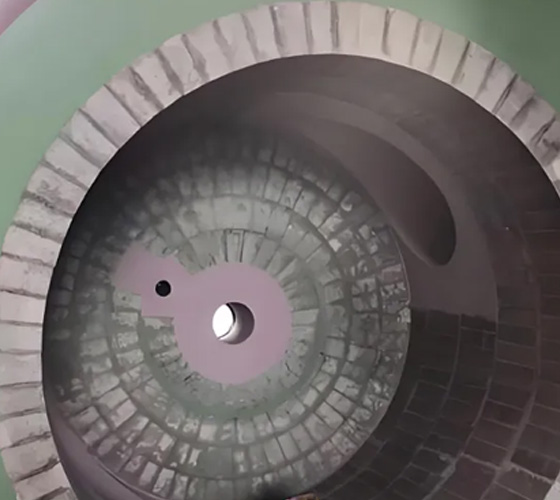
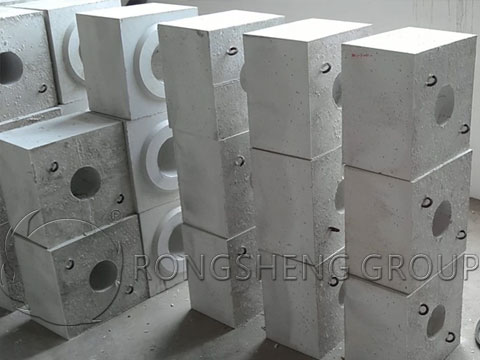
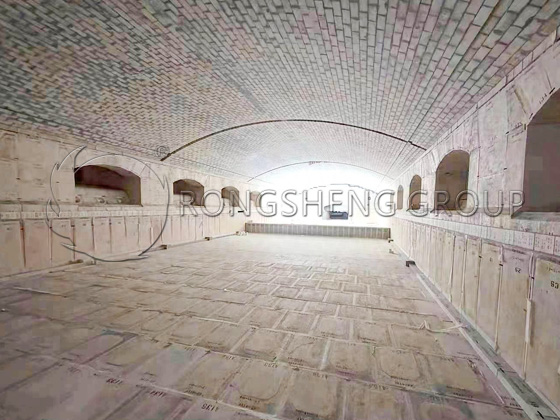
The gasifier serves as the primary component of a pressurized coal-water slurry gasification unit, and the quality of the refractory bricks used in its construction is the principal factor determining the gasifier’s operational cycle. Gasifier operation entails conditions of extreme temperature and high pressure. Oxygen and coal slurry are injected into the gasifier through opposing process burners; the resulting head-on collision creates six distinct flow zones, which significantly intensifies the erosive scouring of the refractory lining. Furthermore, furnace temperatures undergo rapid and drastic fluctuations during startup and shutdown procedures. Consequently, the refractory lining is required to possess superior resistance to slag corrosion and penetration, high hot strength, and excellent volumetric stability at elevated temperatures. The gasifier furnace chamber is segmented into three distinct sections: an upper dome section, a central cylindrical section, and a lower conical bottom section incorporating the slag tap. These three sections function independently of one another, thereby facilitating the removal or replacement of individual components. The rate of refractory brick erosion varies across different sections; operational experience indicates that the refractory bricks in the arch section exhibit the most rapid rate of erosion.
Characteristics of Refractory Linings in Gasifiers
The new multi-nozzle opposed-flow gasifier utilizes domestically produced refractory materials. The refractory brick structure within the gasifier’s combustion chamber consists of three distinct layers: the hot-face bricks, the backing bricks, and the insulating bricks.
Hot-Face Bricks
Since the hot-face bricks are in direct contact with the coal slag, they constitute the most critical section of the gasifier’s refractory lining—the area subjected to the most severe operating conditions. Consequently, 90% Cr-Al-Zr bricks (commonly referred to as “high-chrome bricks”) are selected for this application. The primary raw material used in these Cr-Al-Zr bricks is Cr2O3, which imparts excellent thermal stability as well as superior resistance to high-temperature slag, gas-flow erosion, and chemical corrosion.
Backing Bricks
Positioned behind the hot-face bricks, the backing bricks play a vital role in providing mechanical support to the entire refractory lining structure of the gasifier; therefore, Cr-corundum bricks are chosen for this layer. Cr-corundum bricks exhibit high strength at ambient temperatures, excellent chemical stability, and superior load-bearing capabilities, in addition to possessing outstanding resistance to coal slag corrosion and high-temperature creep.
Insulating Bricks
Situated behind the backing bricks, the insulating bricks serve to provide thermal insulation for the gasifier, thereby minimizing heat loss. For this purpose, alumina hollow-sphere bricks are selected. Alumina hollow-sphere bricks are characterized by their distinct thermal insulation properties and low thermal conductivity; they are a lightweight refractory material that offers excellent high-temperature resistance and energy-saving performance. They demonstrate exceptional stability across a wide range of atmospheric conditions and possess excellent resistance to corrosive gases, as well as a strong capacity to buffer thermal stresses.
Heavy-Duty Castables (Cr-Corundum Castables)
Cr-corundum castables are utilized for lining the spherical dome and the conical bottom of the gasifier. Compared to refractory bricks, castables offer several distinct advantages: they are joint-free (thereby ensuring excellent structural integrity), and they facilitate convenient installation—particularly in areas involving complex structural geometries. Cr-corundum castables exhibit superior resistance to coal slag corrosion, high mechanical strength at elevated temperatures, and minimal linear dimensional change under thermal stress; furthermore, they maintain stable long-term performance within high-temperature, high-pressure, and reducing atmospheric environments.
Chrome Corundum Brick for Refractory Linings in Gasifiers
The service life of refractory bricks in the arch roof is critical to the operation of novel gasification furnace processes; it constitutes a major limiting factor regarding the long-term, stable operation of the furnace, leading to interruptions in continuous system operation and increased maintenance costs. Statistics indicate that for each gasification furnace, a single cycle of arch brick replacement requires approximately 40 days and incurs direct costs of approximately 1.2 million RMB. Through studies of the flow field distribution within the gasification furnace and the structural characteristics of the refractory bricks—combined with an analysis of the internal operating conditions—a comprehensive investigation into the causes of refractory brick deterioration was conducted, and corresponding remedial measures were subsequently implemented.
Structural Design Issues
Insufficient Thickness of the Arch Crown Hot-Face Bricks
The hot-face bricks have a nominal thickness of 200 mm. When the thickness of these hot-face bricks erodes to one-third of their original dimension, the refractory bricks are deemed to have reached the end of their service life and can no longer be utilized. Field measurements of the erosion rate of the arch crown bricks indicate that their relatively thin initial thickness—combined with a rapid rate of erosion—constitutes the primary factor contributing to the short overall service life of the refractory lining.
Prior to the modification, the arch crown lining of the new gasifier was designed as a three-layer system: an innermost layer of hot-face bricks, a middle layer of backing bricks, and an outermost layer of insulating bricks. Following the modification, the refractory structure in the arch crown section was revised from the original three-layer design to a two-layer system: an inner layer of hot-face bricks and an outermost layer of heavy-duty castable refractory, thereby eliminating the intermediate layer of backing bricks. This modification involved replacing the original backing bricks with additional hot-face bricks, effectively increasing the overall thickness of the hot-face layer. This increased thickness extends the time required for erosion to occur, thereby prolonging the service life of the refractory lining within the arch crown section.
Flawed Design of the Sealing Bricks
The sealing bricks were originally designed as cylindrical components. Their primary sealing interface—the lateral surface of the sealing brick—relied on a gap-type seal against the adjacent “B” bricks, with a nominal design clearance of 2 mm. In practice, however, both the manufacturing and masonry installation processes for refractory bricks are subject to inherent tolerances. Furthermore—particularly during secondary installations of the sealing bricks following periods of gasifier operation—it is often impossible to completely remove residual slag adhering to the sealing surfaces. Additionally, as the sealing bricks are pre-cast components, they typically exhibit manufacturing dimensional tolerances of approximately ±2 mm. Given these combined factors, the actual clearance required for the sealing bricks to be successfully installed exceeds 4 mm. Consequently, this excessive clearance results in poor sealing effectiveness, leading to repeated instances of gas leakage and localized overheating within the arch crown neck area. Ultimately, this structural flaw contributes to the short service life of the gasifier arch crown pre-cast components.
Modifications were implemented to the structural design of the gasifier’s top sealing bricks as follows:
1) The geometry of the gasifier’s top pre-cast components was revised from the original cylindrical boss configuration to a conical boss configuration.
2) The thickness of the “B” bricks was increased, and the dimensions of the preheating ports were reduced; specifically, the preheating ports were redesigned from cylindrical bores into conical bores. Additionally, the design of the “A” bricks—which sit directly adjacent to the “B” bricks—was revised to create a new “A1” brick type, with the specific objective of providing enhanced protection for the “B” bricks.
3) Based on a summary of multiple inspections of the gasifier’s hot-face refractory lining, it was identified that the rapid erosion of the arch bricks—specifically those ranging from type B to type K—constituted a critical weak point in the gasifier structure. Consequently, we redesigned and improved the refractory lining for the arch; specifically, we modified the arch bricks by increasing the number of tongue-and-groove joints from one to two, thereby establishing an additional line of defense against joint erosion.
As a result of the aforementioned modifications, the issues of gas leakage and localized overheating at the gasifier arch neck have been effectively mitigated, thereby extending the service life of the gasifier arch precast components.
Raw Material Factors
The Influence of Coal Ash Fusion Point
Simply put, the ash fusion point is the temperature at which the ash content begins to melt. The ash content of coal is constituted by elements such as silicon, aluminum, iron, magnesium, potassium, calcium, sulfur, and phosphorus, as well as compounds in the form of carbonates, silicates, sulfates, and sulfides. The ash fusion point of the coal determines the operating temperature of the gasifier; if the ash fusion point is low, the operating temperature is correspondingly lower, which is beneficial for protecting the refractory bricks. Conversely, if the ash fusion point is high, the operating temperature must be raised accordingly; this results in increased thermal radiation within the furnace, thereby accelerating the rate of thermal erosion on the refractory bricks.
The magnitude of the ash fusion point is directly related to the composition of the ash. If the proportion of SiO2 and Al2O3 in the ash is higher, the melting temperature will be higher. Conversely, if the proportion of basic components—such as Fe2O3 and MgO—is higher, the melting temperature will be lower. This can be adjusted by adding fluxing agents. Coal ash slag is predominantly acidic in nature; therefore, basic fluxing agents—typically CaO, or CaCO3 (which generates CaO upon pyrolysis)—are often selected to adjust the ash properties. Alternatively, coal blending techniques can be employed to control the ash fusion point of the coal fed into the furnace. Generally, the ash fusion point of coal used for gasification is controlled to remain below 1300°C.
The Influence of Slag Viscosity
The novel multi-nozzle opposed-flow gasifier utilizes a liquid slag discharge system. As the operating temperature increases, the viscosity of the slag decreases, thereby facilitating slag flow. However, if the slag viscosity becomes excessively low, the refractory bricks are exposed directly to the high-temperature gas stream, which intensifies erosion and spalling. Conversely, if the operating temperature is too low, the slag viscosity increases; this hinders slag flow and creates a propensity for slag accumulation, potentially leading to blockages at the slag tap. Optimal operation within a specific viscosity range is essential to ensure the formation of a protective slag layer of adequate thickness on the surface of the refractory bricks; this not only extends the service life of the refractories but also prevents blockages at the slag tap. Therefore, to safeguard the refractory bricks against erosion by high-temperature gases, maintaining a continuous slag film on their surface is absolutely critical. Consequently, the optimal operating temperature for the novel multi-nozzle opposed-flow gasifier is determined based on the viscosity-temperature characteristics of the specific slag, typically targeting a viscosity level below 250 poise (P).
Process Operation Factors
1. Unreasonable Oxygen Flow Rate at the Burner
An unreasonable oxygen flow rate not only impairs atomization efficiency but also accelerates the erosion of the refractory bricks in the vicinity of the burner. Without altering the overall structural design of the gasifier, the gasifier’s load and operating pressure must be carefully controlled. Based on the results of hot-model experiments and calculations, specific operating loads corresponding to various operating pressures have been established for process burners of different assembly dimensions. The oxygen flow rate should be maintained at ≤ 140 m/s.
2. Frequent Start-ups and Shut-downs
Frequent start-ups and shut-downs of the gasifier induce rapid fluctuations in furnace temperature. This leads to severe thermal stress on the refractory bricks, resulting in cracks in the furnace lining, an accelerated rate of refractory erosion, and a reduced service life for the bricks. Operating conditions should be kept stable to avoid fluctuations, and the frequency of gasifier start-ups and shut-downs should be minimized as much as possible.
3. Operating Temperature
The operating temperature of the gasifier is typically controlled to be 50–100°C above the ash melting point; this ensures the complete gasification of coal and facilitates the smooth discharge of molten slag. If the temperature is too low, the ash and slag cannot be discharged effectively, leading to blockages at the slag tap. Conversely, if the temperature is too high, the rate of erosion and penetration of the refractory bricks by the ash and slag increases. For every 100°C rise in operating temperature, the erosion rate of the refractory bricks increases by a factor of 3 to 4. Furthermore, excessively high temperatures can cause the reduction of Cr₂O₃ within the refractory bricks, leading to structural degradation. Therefore, the operating temperature must be strictly controlled: the lower temperature limit should be set above the temperature corresponding to a slag viscosity of 250 P, while the upper temperature limit should correspond to a slag viscosity of 30–50 P. Additionally, significant temperature fluctuations must be avoided.
4. Operating Pressure
Fluctuations in operating pressure can adversely affect the joints between refractory bricks, leading to gas leakage through the refractory lining of the gasifier and a consequent reduction in the bricks’ service life. Therefore, during system start-ups and shut-downs, pressure adjustments should be executed in strict accordance with established pressure ramp-up and ramp-down curves to avoid excessively rapid changes in pressure. During normal operation, the pressure should be maintained at a stable level to prevent any fluctuations. Following a series of improvements, the service life of the refractory bricks in the arch roof of the new multi-nozzle opposed-flow gasifier has been significantly extended. A comprehensive understanding of the factors contributing to the erosion and degradation of these arch bricks has been established; by implementing corresponding countermeasures based on these factors, the operational lifespan of the arch bricks has been progressively prolonged. Consequently, instances of the new gasifier being forced to shut down due to arch brick overheating have steadily declined. Initially, regarding the service life of the arch bricks in gasifiers A, B, and C, the longest operational cycle recorded was 4,771 hours, while the shortest was merely 1,885.6 hours, with an average duration of approximately 3,500 hours. However, through technical modifications and operational enhancements, remarkable results have been achieved: the refractory bricks in the new gasifier have now attained a service life of 9,700 hours, while those in the older gasifiers have reached 8,500 hours. This success has enabled the realization of long-cycle, stable operation for the entire system.