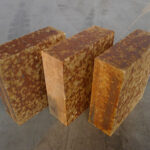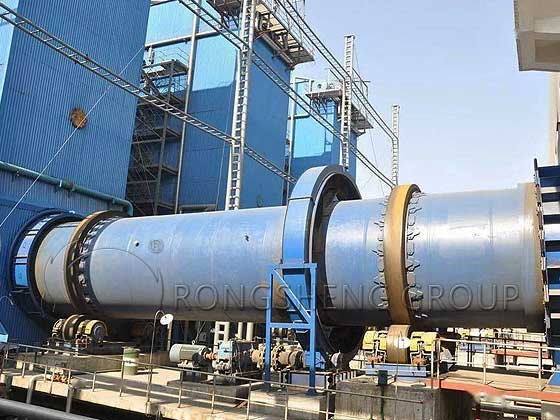
Two silicon-carbide mullite bricks, commonly used in the low-temperature zone of cement rotary kilns, were randomly selected. One was silicon-carbide mullite brick 1680, and the other was silicon-silicon brick 1550. Alkali erosion resistance tests were conducted using the static crucible method. Samples measuring 80 mm × 80 mm × 80 mm were cut from each brick, and a cylindrical groove of φ36 mm × 40 mm was drilled in the center to form a crucible. A 60 mm × 60 mm × 30 mm thin plate was then cut to form the crucible lid. Both the crucible and lid were dried. 20 g of pure chemical K₂CO₃ was added to each crucible, and the lid and crucible were sealed with fire clay. The entire crucible was dried in an oven at 110 °C for 12 h, then placed in an electric furnace and held at 1100 °C for 5 h, followed by natural cooling. The alkali erosion resistance of the samples was evaluated by observing their appearance.
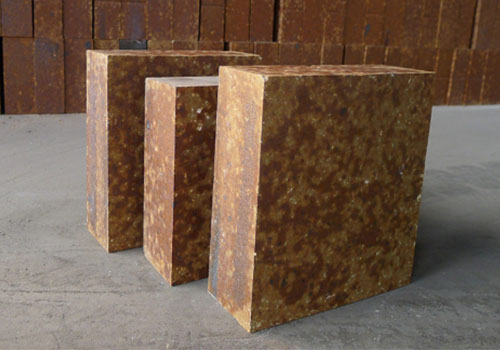
Alkali Erosion Resistance of Silicon-Molybdenum Bricks
Appearance photos of two crucibles after alkali erosion revealed no cracks in silicon-molybdenum bricks 1680 and 1550. The K content variation curves of silicon-carbide mullite bricks 1680 and 1550 were consistent, with the highest content at the bottom of the crucible. As the erosion depth increased, the K content decreased sharply; after a depth of 20 mm, the K content approached 1% and remained relatively stable. The alkali erosion resistance of silicon-molybdenum bricks is related to the introduction of silicon carbide and the apparent porosity of the bricks. The silica generated by the high-temperature oxidation of silicon carbide reacts with potassium carbonate on the refractory brick surface to form a dense glassy phase, effectively inhibiting K erosion and penetration, resulting in a K concentration on the brick surface.
SEM images of the eroded layer of silicon-carbide mullite brick 1680 after alkali erosion at different magnifications for the 0–10 mm area. Observation revealed that the bottom surface of the crucible in contact with K₂CO₃ had a dense structure, with cracks appearing at the edges of large particles. The edges of bauxite particles in the matrix showed significant erosion, while silicon carbide showed no obvious change. The main phase composition of silica-mullite bricks is corundum, mullite, and silicon carbide, with potassium (K) present in the glassy phase. It is evident that at high temperatures, the bauxite in the silica-mullite brick matrix is easily eroded by alkali. The silica produced by the oxidation of bauxite and silicon carbide reacts with potassium to form a liquid phase. This liquid phase fills the pores of the silica-mullite bricks, sealing the pores and cracks in the alkali-contact area, forming a dense layer that hinders further penetration of potassium.
Silica-mullite bricks 1680 and 1550, due to the addition of silicon carbide and its partial oxidation to silica to fill the pores, exhibit excellent resistance to alkali erosion. After alkali erosion tests, potassium was mainly concentrated in the eroded area, and the potassium content decreased sharply with increasing distance.
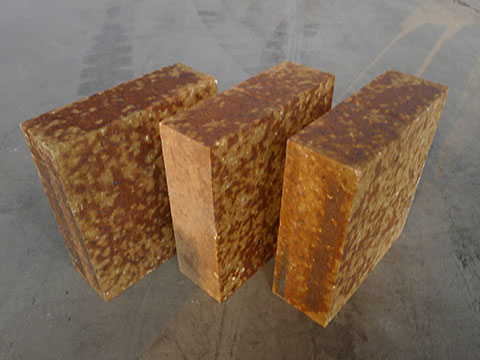
Preparation and Properties of Silica-Mullite Bricks for Cement Rotary Kilns
Silica-mullite bricks are alumina-silicon materials made by sintering silicon carbide, mullite, or bauxite clinker at high temperatures. The main crystalline phases of this material are corundum, mullite, and silicon carbide, with a small amount of cristobalite. Due to its good wear resistance, high mechanical strength, excellent erosion resistance, and thermal shock stability, it can be widely used in all parts of cement rotary kilns except the firing zone. Previous studies have systematically investigated various multiphase materials composed mainly of corundum, mullite, and silicon carbide.
In recent years, with the upgrading of cement production equipment and changes in fuels used, the operating environment of cement kiln lining materials has become increasingly harsh. Some high-temperature properties of ordinary silicon-carbide mullite bricks, especially their thermal shock stability, no longer meet the requirements. Therefore, a series of studies have been conducted on the preparation and properties of silica-mullite bricks.
High-alumina bauxite clinker was used as aggregate, and fused brown corundum, silicon carbide, and α-Al₂O₃ micro powder were added to the matrix. Through reasonable particle size distribution, high-pressure molding and high-temperature firing were employed to prepare high-performance silica-mullite bricks. Experiments showed that the performance of the sample reached its optimal state when the α-Al₂O₃ content was 6%. Its bulk density was 2.64 g/cm³, and its thermal shock resistance exceeded 30 cycles (water-cooled at 1100℃). The high-temperature wear volume was 1.16 cm³, and the load softening temperature was 1700℃ (0.6%). The compressive strength was 152 MPa, and the thermal conductivity was 1.75 W/(m·K). This product was used in the transition zones of large-scale cement rotary kilns (2500 t/d and 5000 t/d) in several cement plants, with a daily wear rate of only 0.1 mm, without any spalling or bursting. The service life was over one year. However, the disadvantages of this product are high raw material costs and high energy consumption during high-temperature firing.
Using high-alumina bauxite clinker and SiC fine powder as the main raw materials, andalusite of three particle sizes (3~1mm, 1~0mm, <0.074mm) was added respectively. The bricks were fired at 1480℃ for 3 hours to investigate the effects of the amount and particle size of andalusite added on the properties of silica-mullite bricks. The experiments showed that the andalusite added to the silicon-carbide mullite bricks mutates at high temperatures, forming a compact, interwoven mullite structure. This structure can resist the propagation of internal cracks during rapid temperature changes, thereby improving the thermal shock stability of the material. The compact mullite structure formed after the andalusite mutates not only improves the thermal shock stability of the material but also increases the load softening temperature of the silica-mullite bricks. Furthermore, the load softening temperature of the silica-mullite bricks gradually increases with the increase of the andalusite addition. However, the high price of andalusite added to these silica-mullite bricks also increases the raw material cost.
Using high-alumina bauxite and silicon carbide as the main raw materials, the effect of zircon sand (67.02% ZrO2, 31.93% SiO2) addition on the performance of silicon-mullite bricks was studied. The results showed that as the zircon sand addition gradually increased, the bulk density and compressive strength of the samples exhibited a trend of first increasing and then decreasing. Furthermore, the thermal shock stability of the samples was significantly improved; when the zircon sand addition was between 10% and 15%, the samples showed superior performance in all aspects.
After adding an appropriate amount of zircon sand to the samples, the specific reaction during firing is shown in the formula 2ZrSiO4 + 3Al2O3 = 3Al2O3·2SiO2 + 2ZrO2 (1). On the one hand, it increases the mullite content in the matrix, improving the high-temperature performance of the silicon-mullite bricks. On the other hand, the generated zirconium oxide, accompanied by a crystal transformation, absorbs the energy of the main crack propagation, eliminates thermal stress, and plays a role in phase transformation toughening, thereby improving the thermal shock stability of the products. However, excessive zircon sand addition will result in excessive mullite formation, causing volume expansion and thus reducing strength.
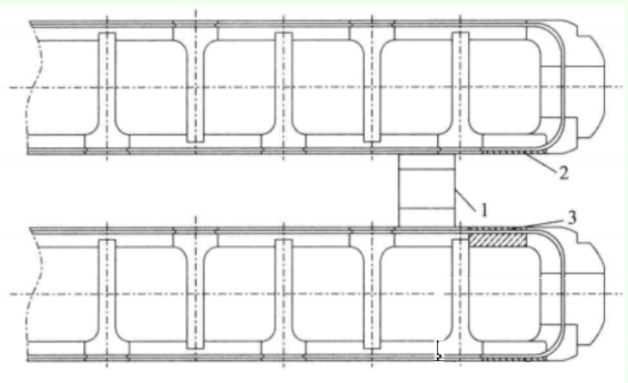
Using mullite, homogeneous bauxite, silicon carbide, and andalusite as main raw materials, a silicon-mullite brick with good thermal shock resistance and low thermal conductivity was developed. The structure and shape of its insulation and heat insulation layers were designed, resulting in a low-thermal-conductivity multilayer composite mullite brick. Experiments showed that using 70% mullite as aggregate, 80% homogeneous material as matrix, and adding 12% silicon carbide and 10-12% andalusite powder, the prepared silicon-mullite brick working layer exhibits a high load softening temperature and good thermal shock resistance. When the silicon-carbide mullite brick working layer and insulation layer form an embedded arc-shaped joint structure, and the insulation layer opening is a trapezoidal dovetail groove structure with a 45° bevel angle, the prepared low-thermal-conductivity multilayer composite mullite brick has low thermal conductivity and good thermal matching between the brick layers. This product has achieved good results in the transition zone of cement rotary kilns. Compared with traditional silica-mullite bricks, this method can reduce the kiln temperature by 50-80℃, playing a positive role in energy conservation, emission reduction, and the lightweighting of kilns in the cement industry.
Silica-mullite bricks were prepared using high-alumina bauxite clinker and silicon carbide as the main raw materials. The effects of silicon carbide particle size and addition amount on the performance of silicon-carbide mullite bricks were studied. The results showed that when the silicon carbide addition amount was 15%-20%, the silica-mullite bricks exhibited better properties. Increasing the addition amount of fine particles was beneficial to improving the compressive strength and reducing the apparent porosity of the samples. Increasing the particle size of the fine powder was beneficial to improving the thermal shock resistance of silicon carbide. The silica-mullite bricks with the best performance were obtained when silicon carbide was added in a composite of two particle sizes.