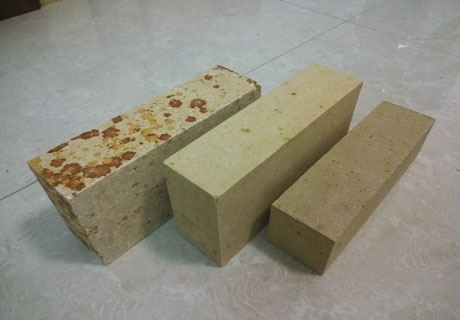
Phosphoric acid reacts negligibly with acidic oxides at room temperature and does not undergo hardening; consequently, it is unsuitable for use as a binder in acidic refractory materials. In contrast, phosphoric acid reacts with amphoteric oxides (such as Al₂O₃) at room temperature to form a hard solid, and the reaction rate between them can be controlled; therefore, it is particularly well-suited for use as a binder in high-alumina refractory materials.
Composition and Properties of Phosphate-Bonded Refractory Castables
-
High-Alumina Refractory Castables
Research into phosphate-bonded high-alumina refractory castables involves the use of Grade I and Grade II high-alumina bauxite clinkers as aggregates and admixtures (fine powders), with orthophosphoric acid serving as the bonding agent. This section details the composition ratios for high-alumina refractory castables bonded with orthophosphoric acid, as well as their physical properties.
For phosphate-bonded high-alumina refractory castables, the typical composition ratio (by weight) is as follows: 70% Grade I high-alumina bauxite clinker particles (≤7 mm), 30% Grade I high-alumina bauxite fine powder (200 mesh), 2%–3% high-alumina cement (acting as a setting accelerator), and 11% phosphoric acid solution (with a mass concentration of 50%). The following results illustrate the impact of a liquid aluminum dihydrogen phosphate binder on the properties of high-alumina castables (fabricated using Grade I high-alumina clinker, clay clinker, and raw clay as raw materials):
- 1) High-alumina castables bonded with aluminum dihydrogen phosphate—specifically those with a molar ratio of n(P2O5):n(Al2O3) = 3—exhibit significantly superior flexural strength and thermal shock resistance compared to those bonded with water glass (modulus: 2.4–2.8; bulk density: 1.36–1.38 g/cm³) or aluminum sulfate (mass concentration: 33%–45%; bulk density: 1.2–1.3 g/cm³).
- 2) When the phosphoric acid used to prepare the aluminum dihydrogen phosphate solution has a mass concentration of 65% and the molar ratio is n(P2O5):n(Al2O3) = 3, the resulting high-alumina castable demonstrates the highest flexural strength (>9 MPa). Furthermore, its thermal shock resistance (tested at 900°C with 5 cycles of air cooling) is also excellent, retaining 55% of its original flexural strength.
- 3) The optimal addition rate for the aluminum dihydrogen phosphate solution is 12% (by weight). Under these conditions, the castable exhibits a flexural strength of 8.83 MPa, a refractoriness under load of 1425°C, and an apparent porosity of 22.6%. After undergoing five cycles of air cooling at 950°C, the material exhibited a flexural strength retention rate of 69.5%, demonstrating good thermal shock resistance.
- 4) The selection of a high-alumina castable bonded with a composite binder—specifically, a 1:1 volume ratio mixture of aluminum dihydrogen phosphate and aluminum sulfate—satisfies the basic performance requirements for the material: a flexural strength of 6.63 MPa, a refractoriness under load of 1415°C, an apparent porosity of 22.7%, and a residual strength retention rate of 68.7% after five cycles of air cooling at 950°C.
A high-alumina castable was prepared using 70% (by weight) calcined high-alumina bauxite as aggregate, 30% (by weight) fine corundum and bauxite powders as the matrix, and supplementary additions of 4% (by weight) SiO2 microsilica, 3% (by weight) soft clay, and 1.5%–2% (by weight) alkaline hardener. The influence of liquid aluminum dihydrogen phosphate on the castable’s performance was investigated. The results indicated that optimal castable performance is achieved when the aluminum dihydrogen phosphate has a mass concentration of 50%, a molar ratio of n(P2O5):n(Al2O3) = 3, and is added at a dosage of 12%–15% (by weight).
The molding process for the aluminum dihydrogen phosphate-bonded high-alumina castable is as follows: Raw materials are weighed according to the prescribed formula and mixed thoroughly in a mixer; half of the binder is then added, followed by 3 minutes of mixing. After achieving a uniform blend, the mixture is allowed to age (temper) for 10 hours. Subsequently, the remaining half of the binder is added to the aged mixture, followed by another 3 minutes of mixing. The material is then cast into molds, allowed to undergo natural curing for 24 hours, demolded, dried, and finally subjected to heat treatment.
-
Rapid-Heating, Abrasion-Resistant Castable for Circulating Fluidized Bed Boilers
A rapid-heating, abrasion-resistant castable designed for use in circulating fluidized bed (CFB) boilers. This product is supplied as a two-component system: Component A consists of a wet mixture preparation. In a reaction vessel, 100 kg of industrial phosphoric acid (at an 85% mass concentration) is heated to 90°C, while simultaneously, 80 kg of water and 26 kg of activated aluminum hydroxide are blended into a paste-like consistency. Under continuous agitation, this paste is slowly added to the reaction vessel. Upon completion of the reaction, the resulting liquid mixture is a colorless, transparent colloid with a controlled viscosity of 45 seconds. Concurrently, 180 g of oxalic acid is completely dissolved in 200 g of water; once the liquid mixture in the reaction vessel has cooled to 50°C, the oxalic acid solution is added dropwise into the vessel. After thorough mixing, the liquid mixture is filtered; the resulting filtrate serves as the binder. Next, 90 kg of super-grade bauxite aggregate (particle size 3–1 mm), 110 kg of super-grade bauxite aggregate (particle size ≤1 mm), and 30 kg of the aforementioned binder are simultaneously loaded into a 0.25 m³ high-intensity mixer and blended for 30 minutes to produce the Component A wet mixture; this is packaged in 15 kg bags, ready for use. Component B consists of a dry mixture preparation. In a 0.25 m³ high-intensity mixer, the following ingredients are simultaneously added: 50 kg of α-Al₂O₃ ultrafine powder, 100 kg of semi-white fused corundum ultrafine powder, 40 kg of silica ultrafine powder, 30 kg of electro-fused high-alumina cement, 2 kg of rare earth additives, 1 kg of anti-explosive fibers, 1 kg of an expansion agent, and 0.5 kg of a water-reducing agent. These ingredients are blended for 30 minutes to produce the Component B dry mixture, which is packaged in 4 kg bags, ready for use. For application, one bag of Component A and one bag of Component B are combined and mixed thoroughly—either manually or mechanically—at which point the mixture is ready for installation. Performance characteristics of this phosphoric acid-bonded, abrasion-resistant castable are detailed below.
-
Corundum-Mullite Wear-Resistant Refractory Castable
An invention patent titled “Corundum-Mullite Wear-Resistant Refractory Castable.” Preparation of the Binder: Consists of 20–30% (wt) industrial aluminum hydroxide powder, 67–79% (wt) phosphoric acid (with a mass concentration of 45%), and 1–3% (wt) chromium oxide micropowder. After uniformly mixing these three raw materials, the mixture is slowly heated to 90–100°C and held at this temperature for 30–60 minutes to complete the preparation. Preparation of the Additives: Consists of 60–80% (wt) white corundum powder, 15–25% (wt) activated alumina micropowder, 5–15% (wt) silica fume, 3–8% (wt) sodium tripolyphosphate, and 1–5% (wt) sodium borate; the raw materials are co-milled in their respective proportions for 20–30 minutes. The hardener used is pure calcium aluminate cement. Preparation of the Wet Mix: Uses corundum and mullite as aggregates, comprising 10–30% (wt) of the 8–5 mm fraction, 10–30% (wt) of the 5–3 mm fraction, and 15–35% (wt) of the 3–0.5 mm fraction; the additives constitute 30–50% (wt), and the binder constitutes 10–18% (wt). Preparation of the Castable: Consists of 89–96% (wt) wet mix, 2–6% (wt) hardener cement, and 2–5% (wt) binder.
The physicochemical properties of this castable are as follows: w(Al₂O₃) ≥ 90%, w(SiO₂) ≥ 5%. Bulk density ≥ 3.00 g/cm³; refractoriness: 790°C; thermal shock resistance ≥ 25 cycles. After treatment at 110°C for 24 hours: compressive strength ≥ 90 MPa; flexural strength ≥ 12 MPa; linear change rate: -0.2% to +0.2%. After treatment at 1100°C for 3 hours: compressive strength ≥ 160 MPa; flexural strength ≥ 28 MPa; linear change rate: -0.4% to +0.4%.
-
High-Strength Aluminum Phosphate-Bonded Corundum Castable
A high-strength aluminum phosphate-bonded corundum castable was developed using powdered solid aluminum dihydrogen phosphate—containing w(P2O5) ≥ 65% and w(Al2O3) ≥ 17%—as the binder, with the addition of 6% (by weight) MgO as a setting accelerator and 0.15% (by weight) NH-66 as a corrosion inhibitor. The composition consists of 60% (by weight) brown corundum aggregates and 40% (by weight) fine corundum powder, with a water addition of 3% to 5% (by weight).
Construction Process for Phosphate-Bonded Refractory Castables
During the production of phosphate-bonded high-alumina refractory castables, raw materials must undergo iron removal, or, whenever possible, highly pure raw materials should be utilized. To prevent swelling caused by the reaction between phosphoric acid and iron, an acid inhibitor may be added. The casting process is as follows: Accurately weigh all raw materials according to the prescribed formula, and thoroughly mix the aggregates and fine powders in a forced-type mixer until uniform. Add 8%–9% (by weight) of phosphoric acid (at a concentration of 50%) and mix thoroughly; then discharge the mixture from the mixer, cover it with plastic film, and allow it to “age” (rest) for 24 hours. Subsequently, add 2%–3% (by weight) of high-alumina cement to the mixer and mix thoroughly again. Finally, add the remaining 4%–5% (by weight) of phosphoric acid, mix well, pour the mixture into the prepared molds, and consolidate it using vibration casting.
The molds used for forming must be coated with oil or lined with paper beforehand—especially new molds—to prevent the finished product from adhering to the mold. Failure to do so could result in severe damage to the mold or even render demolding impossible. For products containing internal cores, specifically, the core molds must be extracted 1 to 2 minutes prior to the onset of initial setting. Once the material has hardened slightly, it may be demolded; it is then dried at 110°C for 20 to 32 hours, followed by heat treatment at 500°C to 600°C for 16 to 20 hours.
Phosphate-bonded high-alumina refractory castables do not set at room temperature; therefore, setting accelerators must be added to produce cold-setting castables. Under ambient temperature conditions, only weakly basic oxides with small ionic radii—as well as amorphous oxides—exhibit effective bonding properties. Among alkaline earth metals, bonding properties are manifested only when the ionic radius is less than 0.097 nm. Reported setting accelerators include: activated aluminum hydroxide, α-Al₂O₃ micropowder, talc, NH₄F, electrofused and sintered MgO, alumina cement, basic aluminum chloride, and asbestos, among others. When using MgO as a setting accelerator for aluminum dihydrogen phosphate-bonded castables, fine particles of electrofused magnesia (typically <0.125 mm) are generally added at a concentration of 1% to 1.5%. The reaction between aluminum dihydrogen phosphate and magnesium oxide proceeds as follows:
Based on the premise that the hardening of aluminum phosphate is influenced by the ratio of positive to negative ions, it is proposed that when using electrofused magnesium oxide, optimal hardening characteristics are achieved when the molar ratio n(Al2O3 + MgO) / n(P2O5) falls within the range of 1.35 to 1.45. In other words, precisely determining the ratio of the hardener to the binder—specifically, the ratio of the total cations to anions contributed by both the hardener and the binder—is of critical importance.
The changes observed upon heating the aluminum dihydrogen phosphate–magnesium oxide system are as follows:
Furthermore, the process is considered to involve the solid solution of MgO within the AlPO4 matrix, leading to the formation of magnesium phosphate [Mg3(PO4)2], a low-melting-point substance with a melting point of 1184°C. When fine MgO powder is employed as a setting accelerator in phosphate-bonded high-alumina castables, it undergoes the following reaction with phosphoric acid at ambient temperature, thereby inducing the setting and hardening of the refractory castable. Since the reaction between MgO and phosphoric acid is rapid, its dosage must be strictly controlled to ensure an appropriate setting and hardening rate that meets construction requirements.
When calcium aluminate cement is added to phosphate-bonded high-alumina castables, hydrated monocalcium phosphate and dicalcium phosphate are formed. Differential thermal analysis (DTA) and X-ray diffraction (XRD) patterns reveal the reaction products formed between CA-50 cement and phosphoric acid. The hardening mechanism of phosphate-bonded refractory castables is attributed to phosphate ions sequestering metal ions from the setting accelerator, resulting in the formation of phosphates—specifically hydrated phosphates—that possess excellent cementing properties, or by inducing the precipitation of reaction products. In refractory castables formulated with phosphate binders, the addition of a setting accelerator triggers a hardening mechanism analogous to the aforementioned process; the actual rate of setting and hardening is contingent upon both the type and the dosage of the accelerator employed.
The dosage of high-alumina cement exerts a significant influence on the performance characteristics of phosphate-bonded high-alumina castables. When aluminum hydroxide is utilized as a setting accelerator, chemical reactions may occur both during the ambient-temperature hardening phase and throughout the subsequent heating process.
Following heat treatment at 500°C, XRD analysis confirms the presence of β-Al(PO3)3 as well as the low-temperature polymorph of AlPO4. Upon reaching temperatures exceeding 586°C, the AlPO4 phase—which initially exists in the berlinite-type (α) structure—undergoes a polymorphic transformation into the β-type structure. At 1065°C, the quartz-type AlPO4 transforms into the cristobalite-type AlPO4. When the temperature exceeds 1300°C, the cristobalite-type AlPO4 decomposes into Al2O3 and P2O5. Upon formation, the P2O5 continuously sublimes and is expelled.

Manufacturing Process and Properties of High-Alumina Phosphate-Bonded Castable Precast Blocks
Manufacturing Process and Properties of High-Alumina Phosphate-Bonded Castable Precast Blocks for Hot Blast Stoves:
(1) Mold Preparation.
Since phosphoric acid reacts with iron, leading to severe adhesion to the mold, wooden molds are generally used. After the mold has passed inspection, a thin layer of plastic sheeting or paper is laid inside prior to charging, followed by the application of a layer of butter.
(2) Batching and Aging.
Aggregates and fine powders are weighed according to the prescribed proportions and poured into a mixer. A portion of the phosphoric acid solution is added and mixed thoroughly; the mixture is then placed in an environment with a temperature exceeding 20°C for 16 to 24 hours to allow for the release of hydrogen gas.
(3) Remixing and Compaction.
After the aging process, the mixture is returned to the mixer. First, 2% to 3% bauxite cement is added and mixed for 1 minute; subsequently, 7% (by weight) phosphoric acid solution is added, and mixing continues until the desired consistency is achieved. Each mixing cycle must last no less than 3 to 5 minutes. The mixed material is immediately charged into the mold and transferred to a vibrating table for compaction. Vibration is maintained for a minimum of 6 minutes, or until slurry rises to the surface of the material in the mold and all air bubbles have ceased to escape.
(4) Curing and Demolding.
Following molding, the precast blocks are placed in a room with a temperature exceeding 20°C and left to cure undisturbed for 6 to 8 hours. The side molds may be removed after 2 hours of static curing, while the bottom molds may be removed—allowing for hoisting and transport—after 6 hours.
(5) Physicochemical Properties of the Precast Blocks.
(6) Application and Stove Drying.
The phosphate-bonded castable precast blocks produced fall into two categories: those fired at 1300°C, and those that are unfired. The fired precast blocks are installed in the lower section (0–12 m) of the combustion chamber (fire well) of an internal-combustion hot blast stove, while the unfired blocks are installed in the upper section (12–25 m). The stove drying curve is as follows:
The furnace dome temperature ultimately reaches 1400°C, while the waste gas temperature reaches 500°C.
Application of Modular Phosphate Refractory Castable Precast Blocks for Furnace Domes. The raw materials and proportions are as follows: Grade II bauxite aggregate (≤15mm) accounts for 40%, (≤6mm) accounts for 30%, and fine powder (≤0.088mm) accounts for 30%; the binder—phosphoric acid (85% concentration, diluted with water)—is added at 12–14%, and the setting accelerator—bauxite cement—is added at 2–3%. The manufacturing process for the precast blocks involves the following steps: after mixing, the phosphoric acid-bonded refractory castable must undergo a “holding” period (aging); to facilitate lifting, two hoisting hooks are positioned diagonally within each precast block, necessitating the installation of four φ22mm × 0.5mm steel tubes placed in the cooler zones of the block, with the surfaces of the steel tubes wrapped in two layers of oil-impregnated paper. The prescribed heat treatment schedule is as follows:
This material is applied in a walking-beam heating furnace (16,356 mm × 2,204 mm); the heating and soaking zones feature a total of eight burners, each assembled from three individual precast blocks, yielding a service life of over three years.
Phosphate-bonded high-alumina refractory materials exhibit the following characteristics: they are unaffected by ambient temperature fluctuations—particularly during winter—setting rapidly to facilitate easy demolding without the formation of cracks; they possess no “low-strength zones” under hot conditions (exhibiting particularly high strength in the medium-to-low temperature range); they demonstrate high refractoriness; excellent resistance to slag corrosion; and superior resistance to spalling and thermal shock.