In recent years, with rapid economic development and accelerated urbanization, the amount of industrial and domestic waste generated has continued to increase, becoming a social problem that hinders urban development and affects the quality of life for residents. Cement kiln co-processing technology has achieved the “reduction, harmlessness, and resource utilization” of waste, yielding significant social, environmental, and economic benefits. However, due to the presence of large amounts of harmful components such as sulfur, alkali, and chlorine in waste, these components accumulate in the cement kiln preheater system, making refractory bricks susceptible to erosion, spalling, and damage. Currently, alumina-silicon-based brick products used in the low-temperature zone of cement rotary kilns, such as a series of silica-mullite bricks, anti-spalling high-alumina bricks, and new low-alumina mullite bricks, exhibit significant differences in raw material selection and physicochemical properties. This study compares the alkali erosion resistance of these different products and, combined with microstructure and phase composition analysis, assesses their alkali erosion resistance to optimize the selection and configuration of refractory materials for cement kilns.
Selection of Refractory Bricks
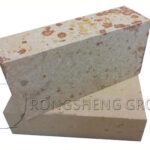
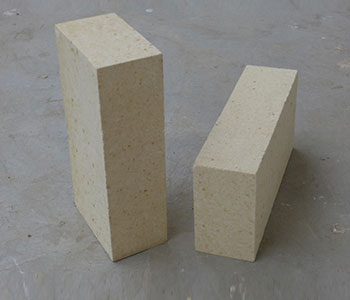
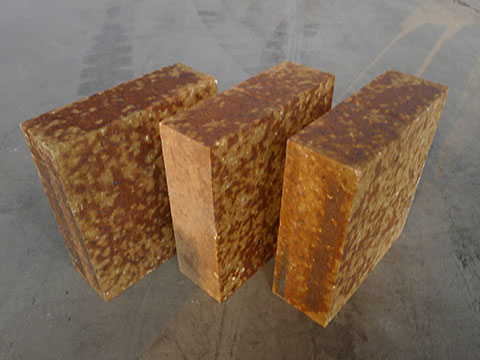
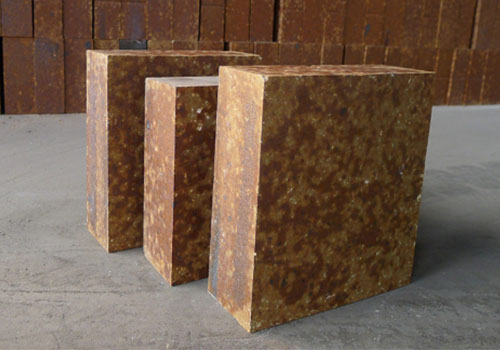
Commercially available silica-mullite brick 1680, silica-mullite brick 1550, anti-spalling high-alumina brick JA, and low-alumina mullite brick M55 were selected. Physicochemical properties of the sample bricks were analyzed.
Alkali Erosion Resistance Test of Four Types of Refractory Bricks
The static crucible method was used for the alkali erosion resistance test. Samples measuring 80mm × 80mm × 80mm were cut from each brick, and a cylindrical groove of 36mm × 40mm was drilled in the center to form a crucible. A 60mm × 60mm × 30mm thin plate was then cut to form the crucible lid. Both the crucible and lid were dried. 20g of commercially available chemically pure K₂CO₃ was added to each crucible, and the gap between the lid and the crucible was sealed with fire putty. The entire crucible was dried in an oven at 110℃ for 12 hours, then placed in an electric furnace and held at 1100℃ for 5 hours, followed by natural cooling. The alkali erosion resistance of the samples was evaluated by observing their appearance. Microstructure and phase composition analysis were performed on the eroded area at the bottom of the crucible. The crucible was divided into zones every 5 mm from the bottom to the bottom of the brick sample, and the potassium (K) content in each zone was analyzed using EDS. X-ray diffraction was used to detect the phase composition of the 0-10 mm eroded metamorphic layer at the bottom of the crucible.
Appearance Analysis of the Crucible after Erosion Test
From the appearance photographs of the four crucibles after alkali erosion, it was found that silica-mullite brick 1680, silica-mullite brick 1550, and low-alumina mullite brick M55 showed no cracks, indicating excellent resistance to alkali erosion. However, the high-alumina brick JA, which resists spalling, showed large through-cracks, indicating relatively poor alkali resistance.
K Distribution at the Bottom of the Crucible after Erosion
EDS surface scanning was performed on the bottom of the crucibles close to each zone line to determine the K content. It can be seen that the K distribution varies greatly among different bricks. The K content variation curves of silica-mullite brick 1680 and silica-mullite brick 1550 are consistent, with the K content reaching its maximum at 0 mm. As the erosion depth increases, the potassium (K) content decreases sharply, reaching approximately 1% (w) after 20 mm and then remaining constant. The K content distribution curves are similar in both the anti-spasting high-alumina brick JA and the low-alumina mullite brick M55. The high-alumina brick JA shows the highest K content at 0, 5, and 10 mm. In the low-alumina mullite brick M55, the highest K content is at 0 and 5 mm. After reaching their highest values, the K content decreases sharply with increasing distance from the bottom of the crucible. In the high-alumina brick JA, the potassium (K) content approaches 1% (w) after 30 mm and then remains constant. In the low-alumina mullite brick M55, the potassium (K) content approaches 1% (w) after 20 mm and then remains constant.
The alkali erosion resistance of silica-mullite bricks is related to the introduction of silicon carbide and the apparent porosity of the silica-mullite bricks. The silica produced by the high-temperature oxidation of silicon carbide reacts with potassium carbonate on the surface of refractory bricks to form a dense glassy layer, effectively inhibiting the erosion and penetration of potassium (K), thus concentrating K in the surface area of the brick. High-alumina bricks and low-alumina mullite bricks, which are resistant to spalling, have high apparent porosity. These pores provide rapid penetration channels for molten potassium carbonate. Potassium carbonate enters the brick interior through these pores and reacts with the brick at high temperatures to form minerals such as nepheline or leucite. The formation of nepheline or leucite causes significant volume expansion, leading to brick cracking. High-alumina bricks with high apparent porosity have a higher K content at the same depth than low-alumina mullite bricks with lower apparent porosity, and their K enrichment is greater in the surface area.
Microstructure and Phase Composition Analysis of the 0- 10 mm Etched Layer of Silicon Mullite Brick 1680
SEM images of the 0- 10 mm etched layer of silicon mullite brick 1680 after alkali etching at different magnifications. The images reveal a dense surface structure at the bottom of the crucible in contact with K and CO, with cracks appearing at the edges of large particles. It also shows significant erosion at the edges of bauxite particles in the matrix, while silicon carbide shows no significant change.
XRD patterns of the 0- 10 mm etched layer of silicon mullite brick 1680. The phase composition is mainly corundum, mullite, and silicon carbide, with potassium present in the glassy phase.
In the silicon mullite brick matrix, silica, generated from the oxidation of bauxite and silicon carbide, reacts with potassium to form a liquid phase. This liquid phase fills the pores of the silicon mullite brick, sealing the pores and cracks in the alkali-contact area, forming a dense layer that hinders further potassium penetration.
High-alumina brick JA (anti-spalling high-alumina brick)
Microscopic images of the 0- 10 mm area at the bottom of the crucible after alkali etching of the high-alumina brick JA. Observation of the images reveals that the surface structure at the bottom of the crucible becomes denser, the alumina particles are significantly eroded, and the particle structure in the matrix becomes less distinct. It can also be seen that the edges of the matrix particles become very blurred, and pores or grain boundaries are filled with a large number of light-colored new phases. The high-alumina brick JA exhibits high porosity, and potassium carbonate penetrates the brick body along the pores or grain boundaries, eroding the sample to a great depth. Phase analysis of the eroded layer reveals the formation of potassium nepheline. The formation of a large amount of potassium nepheline causes volume expansion, leading to large through-cracks in the high-alumina brick.
Low-alumina mullite brick M55
Microscopic images of the 0- 10 mm area at the bottom of the crucible after alkali etching of the low-alumina mullite brick M55. The photos show that the bottom surface of the M55 low-alumina mullite brick crucible also exhibits a small number of cracks and a denser structure, but this differs significantly from the anti-spalling high-alumina brick. High-magnification observation reveals noticeable erosion at the edges of the dense mullite particles, indicating that potassium carbonate also has a certain erosive and penetrating effect on the low-alumina mullite brick, although this is significantly improved compared to the anti-spalling high-alumina brick. Diffraction patterns show that the main phases of the eroded layer are mullite and a small amount of untransformed andalusite, along with a small amount of potassium nepheline. The raw materials used in the M55 low-alumina mullite brick are homogeneous mullite and andalusite. The homogeneous mullite has a dense structure and contains a certain amount of high-silicon amorphous phase. At high temperatures, potassium integrates into the amorphous phase to form a high-viscosity glassy phase. Simultaneously, the amorphous SiO2 formed by the decomposition of andalusite absorbs some potassium carbonate, also generating a high-viscosity glassy phase, which seals the refractory brick erosion layer and hinders the penetration of potassium. A small amount of potassium carbonate reacts with the XRD pattern of the 0- 10 mm erosion layer of the low-alumina mullite brick M55 to form potassium nepheline. The amount of potassium nepheline formed is low, and the resulting expansion is insufficient to damage the brick structure. Therefore, the low-alumina mullite brick M55 exhibits good resistance to alkali erosion.
Evaluation of Alkali Erosion Resistance of Four Types of Refractory Bricks
- (1) Silicon-mullite bricks 1680 and 1550 exhibit excellent alkali erosion resistance due to the addition of silicon carbide and its partial oxidation to silica, which fills the pores. After the alkali erosion test, potassium (K) was mainly concentrated in the eroded area, and its content decreased sharply with increasing distance.
- (2) Commercially available anti-stripping high-alumina brick JA has high apparent porosity and poor alkali erosion resistance, with an alkali erosion depth reaching 10 mm. The K content (w) in the eroded layer reaches 20%~25%, generating a large amount of potassium nepheline, leading to brick cracking.
- (3) Low-alumina mullite brick M55 has low apparent porosity, and the homogeneous mullite and andalusite raw materials used have a dense structure. A certain amount of high-silica amorphous phase in the matrix can absorb alkali to generate a high-viscosity glassy phase, further sealing the pores, resulting in an alkali erosion depth of only 5 mm. The amount of potassium nepheline generated by alkali erosion is relatively small, insufficient to destroy the brick structure, resulting in relatively good alkali erosion resistance.