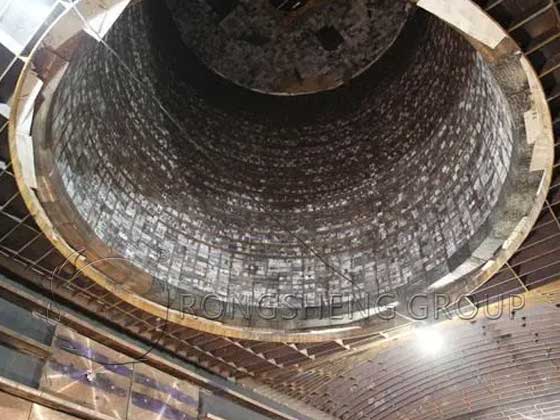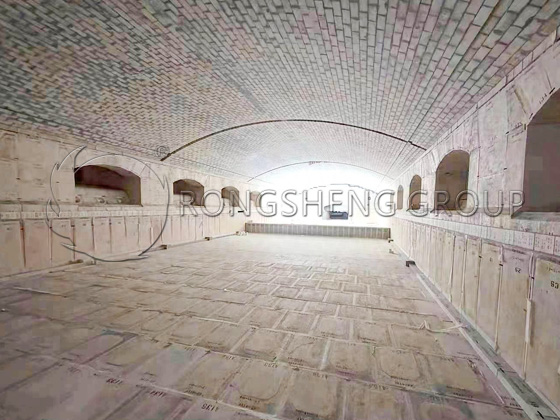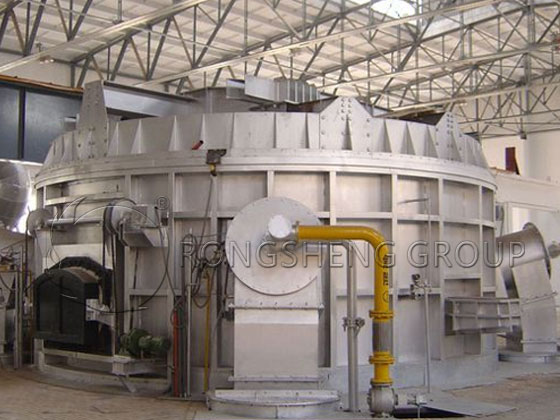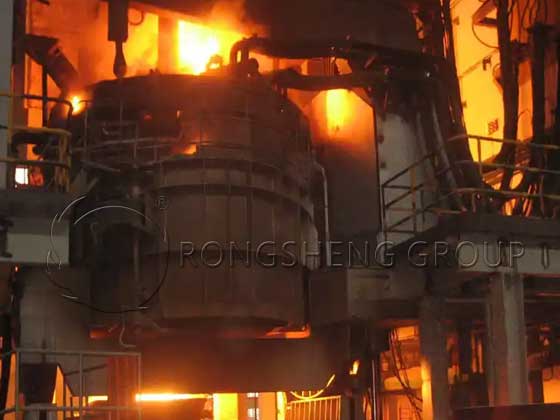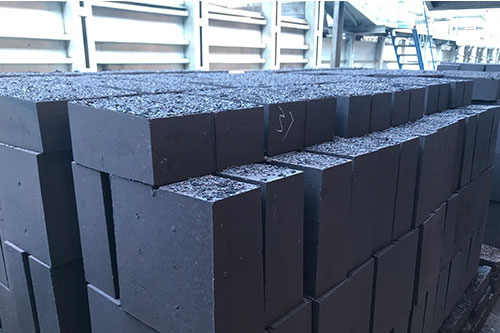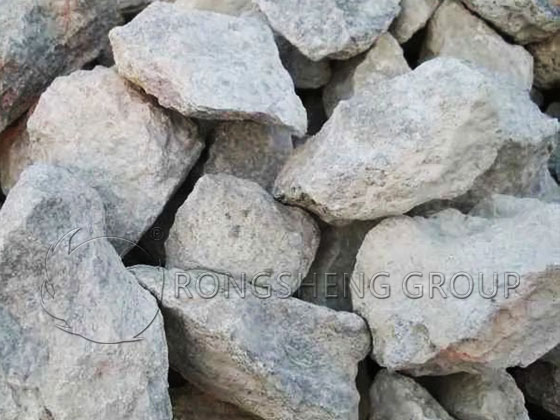
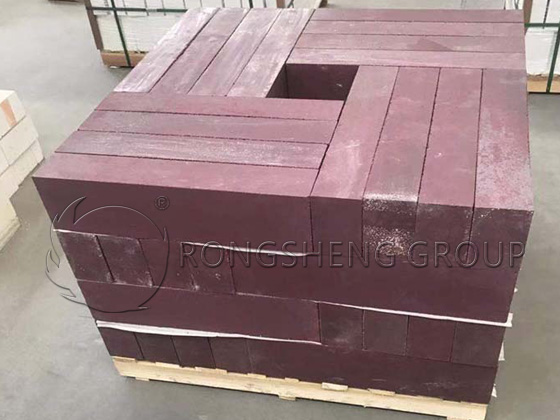
Taking a company’s self-heating copper smelting furnace as an example, it is mainly used to process nickel-containing copper concentrate. This copper concentrate has high nickel content, low iron content, low sulfur content, and no gangue. Based on the furnace conditions and the following principles for selecting refractory materials, we use high-quality magnesia-chrome bricks as the furnace body material and magnesia-alumina spinel bricks as the top material.
Principles for Selecting Refractory Materials for Copper Self-Heating Smelting Furnaces
- (1) Principles for Selecting Top Material: Good thermal stability, good resistance to SO2 atmosphere erosion, and high high-temperature strength.
- (2) Principles for Selecting Furnace Body Material: Strong resistance to matte penetration, good resistance to slag, matte, and gas erosion, and high high-temperature strength.
Adjustment of the Furnace Roof Masonry Structure for the Copper Self-Heating Smelting Furnace
To eliminate thermal stress caused by improper furnace roof masonry, the masonry structure was adjusted while using high-quality magnesia-chrome bricks.
The original design used a flat-lay, tie-column method for the furnace roof magnesia-chrome bricks, as shown in Figure 1. This design resulted in severe brick loss at the oxygen lance and charging pipe locations, leading to burn-through of the furnace roof steel shell and forced shutdown for maintenance, resulting in a short service life.
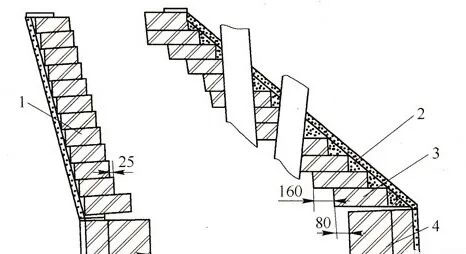
1, 3—Pre-reacted magnesia-chrome bricks; 2—Magnesium powder filler; 4—Directly bonded magnesia-chrome bricks
Therefore, the original flat-lay, tie-column method was improved to a vertical furnace wall arch masonry method. This method focuses on eliminating stress and other factors, creating a unique vertical furnace wall arch masonry structure, as shown in Figure 2.
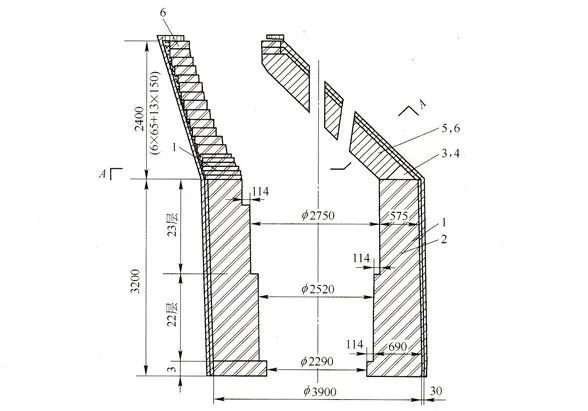
1, 2—Directly bonded magnesia-chrome bricks; 3, 4—Magnesia-chrome triangular bricks; 5, 6—Pre-reacted magnesia-chrome bricks
Improved Usage Results
Usage results showed that the furnace roof structure, constructed with periclase-bonded magnesia-alumina spinel bricks in a vertical furnace wall arch, was tested three times. The furnace life and maintenance status were observed in each test. The furnace roof used periclase-bonded magnesia-alumina spinel bricks, while the furnace body still used magnesia-chrome bricks.
First Test: Brick types used were: 460mm×150mm×85/65mm, 460mm×150mm×85/50mm, irregularly shaped bricks, and 300mm×150mm×75/65mm. After four months of use, an early mid-term overhaul was performed due to annual maintenance. The remaining brick condition at several key points was subsequently measured as follows:
- (1) The remaining brick length between and around the charging pipe and oxygen lance pipe was approximately 250~280mm, remaining in the weakest area of the furnace roof.
- (2) The erosion size of bricks in other parts of the furnace roof was approximately 100~200mm.
- (3) The slag layer thickness of the furnace roof bricks was less than 30mm. (4) A slag shell of approximately 50mm thick was formed on the inner lining of the furnace top, a previously unseen positive phenomenon.
Second Test: The same brick type was used as in the first test. After 6 months of use, the furnace was shut down for maintenance to ensure production in the second half of the year. The extent of erosion on the furnace body and top is unknown.
Third Test: The same brick type was used as the first test. The furnace was shut down for maintenance after 9 months of use. After shutdown, the remaining bricks were inspected and analyzed, revealing that:
- (1) The slag layer on the inner surface of the furnace top was thicker than in the previous two tests, exceeding 100mm. The slag layer thickness of the bricks remained within 30mm.
- (2) Magnesia-alumina spinel bricks are better suited to the operating environment of the self-heating furnace top than reactive magnesia-chrome bricks, exhibiting superior performance. Magnesia-alumina bricks have strong resistance to the scouring and erosion of concentrated SO2 flue gas and molten slag, resulting in a thin slag layer. They exhibit excellent high-temperature performance, forming a slag shell covering the entire inner surface of the dome, with a slag shell thickness reaching 100mm. The high strength at room temperature, good structural stability at high temperatures, and high softening temperature under load successfully solve the problem of short service life in vulnerable areas such as the feed pipe and oxygen lance pipe.
- (3) Analysis of the residual brick cross-section shows that during the 9-month production process, the corrosion dimension of the vulnerable parts at the top of the furnace was 290mm, and the remaining length was over 160mm. Based on an average corrosion rate of 32mm/month (290/9 = 32mm/month), and considering the initial vulnerability and slower corrosion of the furnace top lining, the actual service life of this furnace reached over 16 months.
What is the process of pyrometallurgical copper smelting?
Observations of magnesia-chrome bricks used in the NGL furnace show that the erosion of refractory materials by molten Cu–CuxO is mainly through penetration. This molten material penetrates deep into the magnesia-chrome brick structure, reaching depths of over 260 mm. The bulk density and porosity of the refractory material change with the penetration of the molten material. The porosity of the penetrated layer in the residual brick is significantly lower than that of the original brick layer, while the bulk density increases accordingly, reflecting significant changes in the internal structure and properties of the material.
The surface distribution of elements in the magnesia-chrome brick (penetrated layer) and the characteristic peaks of Cu₂O in the energy spectrum clearly show the penetration morphology of molten Cu–CuxO and other metallic molten materials. The penetration (bright white area) at the interface between fused magnesia sand and the matrix chromite spinel is mainly composed of Cu and O elements. The interface between periclase grains and the matrix chromite spinel is dominated by the penetration of molten cuprous oxide (Cu₂O).
The impurity content of scrap copper in the NGL pyrometallurgical refining process is generally 4%–20%, which is significantly higher than that of molten copper from copper concentrate (0.5%–2.0%). Scrap copper contains metallic elements such as Pb, Zn, As, Sb, Bi, Ni, and Fe. Excessive impurities in the scrap copper from NGL furnace refining necessitate repeated oxidation and slag formation, making the furnace lining refractory material susceptible to erosion. XRD phase and microstructure analysis of the used magnesia-chrome bricks (reaction layer) reveals that the hot surface (reaction layer) of the magnesia-chrome bricks is subjected to the dual effects of NGL slag and molten copper. The slag reacts with MgO particles to form magnesia-olivine (containing iron) and (Mg, Fe, Ni)O solid solutions, which in turn form a multiphase spinel of (Mg, Fe, Ni)(Cr, Al, Fe)₂O₄ with ferrochrome spinel. The XRD phases of the residual brick reaction layer are periclase and ferrochrome spinel, with a small amount of olivine (containing iron) phase. Magnesia particles are susceptible to slag erosion, and some periclase grains are also eroded by the slag, dissolving and forming pores and cracks at the matrix or particle-matrix junctions. Chromite particles do not show deep erosion; at 1700 °C, the solid solubility of FeO and Cr₂O₃ in MgO is 14%, reflecting the good slag penetration resistance of magnesia-chrome refractories.
Due to the diffusion of metals such as iron, nickel, and zinc in NGL slag, especially the high content of iron and nickel, trivalent Fe³⁺ easily diffuses from the chromite spinel, tending to replace Cr³⁺/Al³⁺ to form a new type of high-iron spinel. The chromite spinel in the matrix reacts with the slag around the magnesia particles to form a dense high-iron spinel layer. This dense spinel layer effectively protects the refractory particles and reduces erosion. However, severe slag penetration ultimately leads to densification of the magnesia-chrome bricks near the hot face. Stress accumulation near the interface between the slag-reaction layer and the permeation layer of magnesia-chrome bricks led to the formation and propagation of cracks. On-site observation of used bricks in the NGL furnace revealed significant deep cracks in the slag-reaction layer of the remaining bricks; crack propagation could ultimately lead to structural spalling.