In the daily production processes of the metallurgical industry, a variety of refractory materials are frequently required. Selecting appropriate refractory materials for furnace linings during metal smelting is of great practical significance, as it helps improve operational efficiency and enhances production safety. Given the rigorous demands of the metallurgical sector, these materials must not only possess excellent high-temperature resistance but also exhibit robust resistance to slag corrosion, the effects of molten slag, and erosion from flue gases.
Currently, the refractory materials used in the metallurgical industry can generally be categorized into two types: acidic and basic. Acidic refractories are primarily composed of trivalent oxides and include materials such as mullite bricks, high-alumina bricks, and zirconia-corundum bricks. Basic refractories, by contrast, are primarily composed of divalent oxides and include materials such as magnesia-alumina bricks, magnesia-chrome bricks, and magnesia-alumina spinel bricks.
Design and Application of Refractory Materials for the Bottoms of Lead Smelting Furnaces
Based on long-term practical production experience, a wide variety of furnaces are employed in the lead smelting process to handle different lead-bearing materials. The refractory materials used for the linings of these furnaces typically include high-alumina ramming mixes, magnesia-chrome bricks, and high-alumina bricks.
Permanent Layer of the Smelting Furnace Bottom
When designing the lining for a smelting furnace, the choice of refractory materials varies depending on the specific section of the furnace. For instance, in the case of stationary horizontal smelting furnaces, the materials used for the furnace bottom often include high-alumina bricks, magnesia-chrome bricks, high-alumina ramming mixes, aluminum-chromium spinel, and magnesia-based ramming mixes. Some applications also utilize high-strength, seepage-resistant ramming mixes; these materials are primarily based on the $Al_2O_3$ system, with an $Al_2O_3$ content exceeding 75%. Molten lead has a specific gravity of approximately 10.6 g/cm³ and exhibits extremely high permeability. Consequently, the refractory materials used for the furnace bottom must not only facilitate heat dissipation but also possess exceptional resistance to the penetration of molten lead.
Currently, the standard approach is as follows:
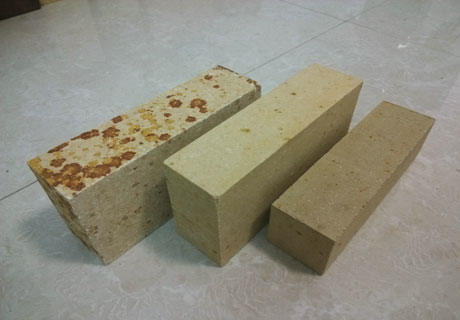
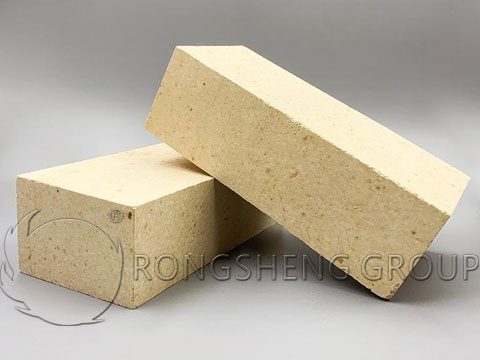
- High-alumina bricks are laid directly onto the steel bottom plate of the furnace. These bricks offer excellent compressive strength—typically ranging from 40 to 60 MPa at room temperature. Furthermore, their thermal conductivity—expressed as $(2.09 + 1.861 \times 10^{-3})t$—is significantly higher than that of magnesia-chrome bricks—$(1.28 + 0.407 \times 10^{-3})t$—making them well-suited for use as a base layer (cushion layer) for the furnace bottom.
- A layer of refractory material specifically designed to prevent lead penetration is then applied over this base layer. Currently, the most widely used refractory materials are high-strength, seepage-resistant ramming mixes—specifically high-alumina and magnesia-based varieties—both of which offer excellent resistance to seepage. For the magnesia-based ramming mix, the composition consists of a 3:7 ratio of fine magnesia powder to magnesia aggregate, mixed with brine. The magnesia aggregate itself is graded as follows: 70% in the 0.2–0.5 mm size range and 30% in the 1.5–3.0 mm range. High-strength, seepage-resistant ramming mixes are formulated using high-alumina aggregates and fine powders of various particle sizes.
Once these refractory materials are baked, the aggregates of different sizes expand, causing them to bond tightly together and effectively prevent the seepage of molten lead. It should be noted that after magnesia-based or magnesia-chrome-based mixes have been rammed into place, they must undergo low-temperature baking to rapidly evaporate any free water. Subsequently, fine magnesia powder is used to fill any expansion gaps, ensuring the rammed material achieves maximum density and strength. It is recommended that the ramming mix be applied in layers 150–300 mm thick; this facilitates efficient, single-pass ramming and ensures more uniform heating during the baking process, ultimately creating a cohesive, seepage-resistant monolithic layer.

Working Layer of the Smelting Furnace Bottom
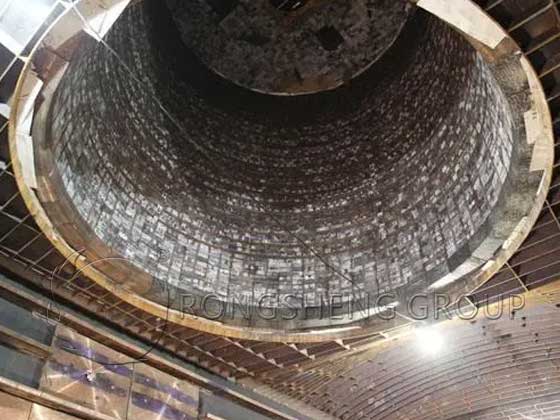
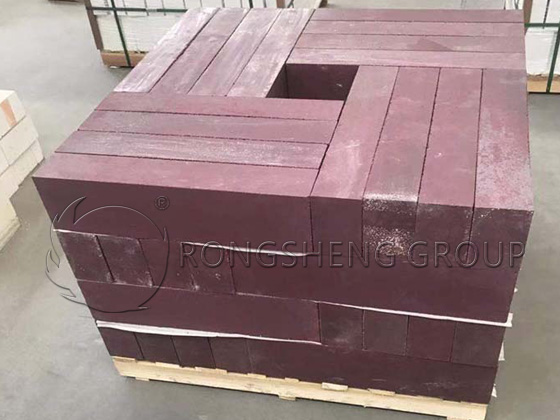
When selecting refractory materials for the working and safety layers of a smelting furnace bottom, magnesia-chrome bricks are commonly used. Magnesia-chrome bricks can be used directly for the safety layer, whereas only semi-rebonded magnesia-chrome bricks are suitable for the working layer. Due to fluctuations in the level of molten lead, the temperature at the furnace bottom varies significantly; therefore, the semi-rebonded magnesia-chrome bricks chosen must possess excellent thermal shock resistance. Alternatively, high-alumina bricks can be used for both the working and safety layers of the furnace bottom. In this type of furnace, the molten lead layer at the bottom can reach a height of 400 mm, which prevents the furnace bottom from being eroded by molten slag. When high-alumina bricks are employed, their $Al_2O_3$ content must be no less than 75%; such bricks are suitable for use as lining material for both the working and safety layers of the furnace bottom.
Working Zones for Refractory Materials in Smelting Furnaces
Generally, the interior of a smelting furnace can be divided into two working zones: the molten bath zone and the gas-phase zone. Consequently, the selection of refractory materials for the furnace interior should be tailored to the specific requirements of each zone.
(I) The Molten Bath Zone
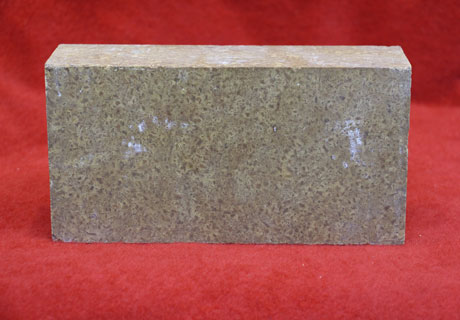
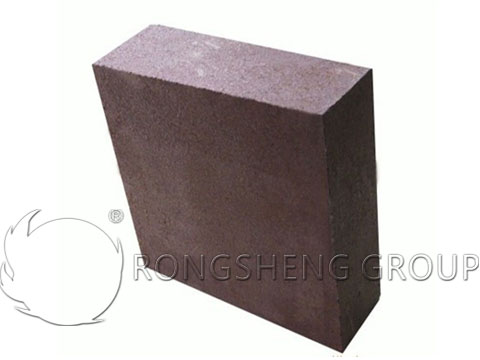
Refractory bricks used in the molten bath zone—particularly along the slag line—are subject to erosion and corrosion by molten slag. In lead smelting, the slag composition is complex; high-alumina refractories can participate in slag-forming reactions and are therefore unsuitable. Instead, magnesia-chrome (MgO-Cr₂O₃) refractories should be used. Furthermore, given the need for high resistance to erosion and corrosion, fused-rebonded magnesia-chrome bricks are an ideal choice, as they offer superior resistance to slag attack compared to semi-rebonded varieties. Increasing the Cr₂O₃ content enhances resistance to slag corrosion; thus, magnesia-chrome bricks with a high Cr₂O₃ content should be widely employed.
(II) The Gas-Phase Zone
Refractory bricks in the gas-phase zone are not directly exposed to the molten bath, though they may be subjected to erosion from splashed slag and the abrasive action of dust-laden flue gases. In this zone, magnesia-chrome bricks with a lower Cr₂O₃ content are suitable. For instance, a lead-reduction furnace at a plant in my country utilized magnesia-chrome bricks. During the initial production phase, the use of direct-bonded magnesia-chrome bricks with a high Cr₂O₃ content led to several issues in the gas-phase zone: the surfaces of the bricks were left exposed (lacking a protective coating of metal or slag), the bricks fractured into two pieces, and their internal structure became excessively porous. A thorough analysis revealed that a significant amount of Fe²⁺ and Fe³⁺ within the refractory bricks was reduced to metallic iron (Fe), which caused the brick structure to become overly loose and porous. Therefore, improvements were made during the maintenance process by utilizing fused-rebonded magnesia-chrome bricks with a relatively low Cr₂O₃ content—specifically, only 12%.
The primary rationale for this improvement is that fused-rebonded magnesia-chrome refractory bricks possess lower apparent porosity and facilitate a reduction in the Fe²⁺ and Fe³⁺ content within the bricks. This makes them better suited to the reducing atmosphere found in the furnace chamber, while also significantly extending their service life. The application of these fused-rebonded magnesia-chrome bricks leads to a notable increase in operational longevity and delivers highly satisfactory performance. The table below provides a comparison of the characteristics and properties of various types of magnesia-chrome refractory bricks.
| Refractory Brick Names | Fused Magnesia-Chrome Grain Added In | Apparent porosity | Bulk Density | High-temperature strength | Erosion resistance |
| Semi-rebonded magnesia-chrome brick | Large amounts | Low | Higher | Relatively high | Good |
| Direct-bonded magnesia-chrome brick | Small amount | Medium | Medium | Moderate | Moderate |
| Fused-rebonded magnesia-chrome brick | Very large amount | Very low | Very High | Extremely high | Excellent |
Proper Selection and Configuration of Refractory Materials for Smelting Furnaces
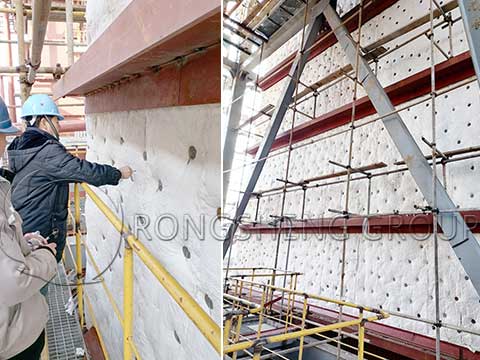
A wide variety of smelting furnaces are currently employed in the lead smelting industry. Many of these furnaces incorporate cooling systems, which effectively extend the service life of the equipment—a feature of significant practical value. In practice, however, the complexity of the raw materials used in lead smelting, combined with high degrees of superheat, means that lead matte can easily erode these cooling systems. Relying solely on cooling systems to facilitate the formation of a protective slag layer (a process known as “slagging” or “freeze-lining”) still presents certain safety risks. Consequently, the cooling systems must also be lined with refractory materials. The appropriate combination of refractory materials and cooling systems allows for complementary advantages, thereby better ensuring safety in lead smelting operations.
The selection and application of refractory materials must be based on the specific characteristics of both the smelting process and the materials being processed. Furthermore, these choices should support the stable operation and extended service life of the smelting furnace, ultimately enabling smelting enterprises to maximize their economic benefits.