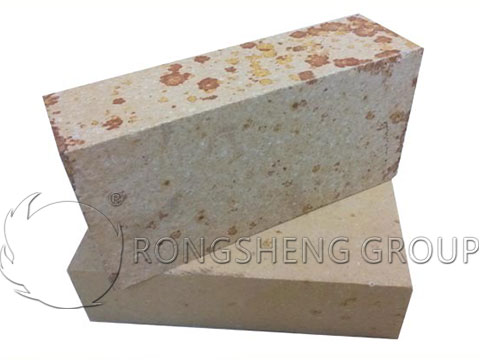
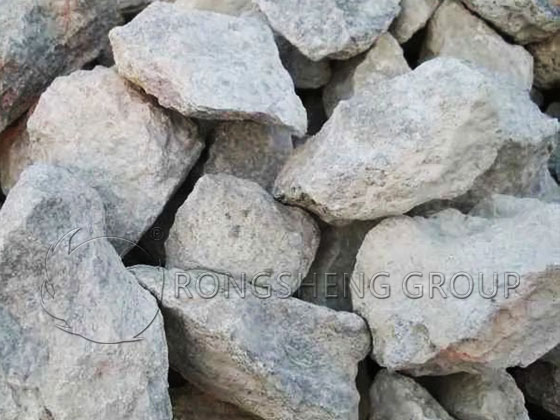
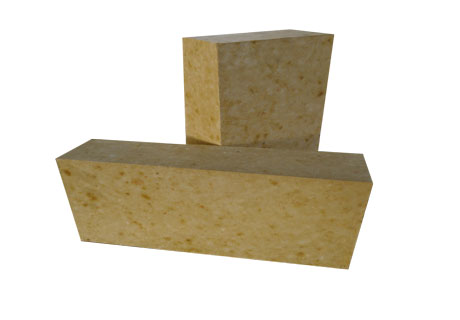
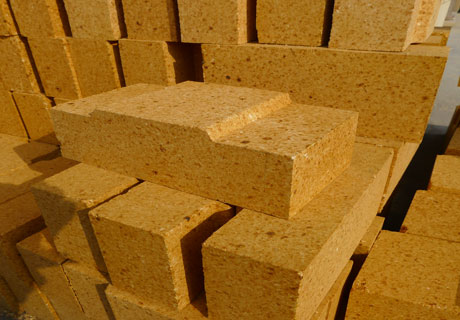
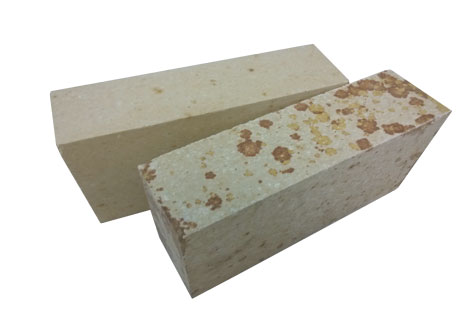
Refractory bricks made from natural silica-containing rocks, primarily quartz, are called silica refractory bricks. Rongsheng Silica bricks contain at least 93% SiO2 and no more than 1.5% Al2O3, as even a small amount of alumina significantly reduces refractoriness. A key aspect of silica brick manufacturing is the rate of conversion between different silica variants.
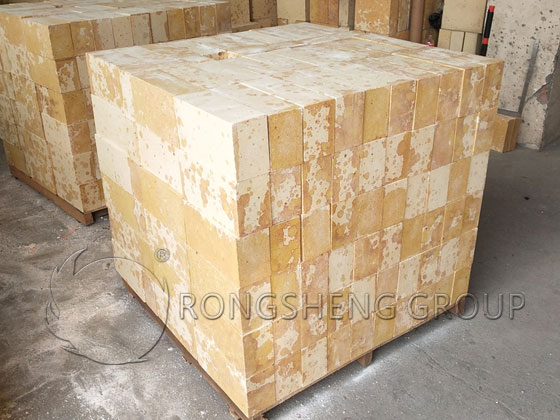
Conversion of Silica Variants in Silica Brick Processing
The high-temperature conversion of the α-α type is difficult because these variants differ in properties and structure. The α⇄β⇄γ type conversion proceeds rapidly because these variants are similar in properties and crystal structure.
The conversion from α-quartz to α-tridymite to α-cristobalite is irreversible. Assuming an instance where α-tridymite or α-cristobalite completely transforms into β-quartz upon heating, cooling will yield not β-quartz, but rather a more substantial γ-tridymite or β-cristobalite. This allows silica to acquire the necessary variants.
The different variants have different densities, so the conversion causes a volume change. The volume change during rapid conversion is essentially smaller than that during slow conversion. These changes are as follows:
Since the volume increase during heating (α→α conversion) is greater than the volume decrease during cooling (α→β→γ conversion), the volume of calcined silica exceeds its original volume. After calcination, the actual residual volume of quartz rock increases by 2%–4%.
Completely converting β-quartz into any of its polymorphs (γ-tridymite or β-cristobalite), thus producing monomineralic silica refractory bricks, is practically impossible. For example, after calcination at 1400-1460℃, some SiO2 remains in the β-quartz form, some transforms into γ-tridymite, and some into β-cristobalite. The proportions depend on the production process. Therefore, it is necessary to determine which polymorph is more favorable. Based on melting point, cristobalite (1728℃) is most favorable, followed by tridymite (1675℃), and finally quartz (1610℃). However, due to the high viscosity of the melt, the difference in melting temperature has no essential impact on the strength properties.
There are significant differences in the volume stability of the polymorphs. Tridymite exhibits relatively small and more uniform expansion across the entire temperature range. Therefore, the production of silica refractories aims to increase the tridymite content of the finished product.
To promote the conversion of quartz into tridymite, mineralizers should be used. Under the influence of mineralizers, quartz transformation and sintering of silica powder occur during recrystallization.
Specific requirements are placed on the mineralizer. It should form a low-viscosity liquid phase at 1200–1450℃ and be capable of dissolving cristobalite, causing silica to transform and recrystallize. Adding mineralizers to the batching process generally reduces the refractoriness of silica bricks. Therefore, the amount of mineralizer should be kept to a minimum. Active mineralizers are K+, H₃O+, and Ba²⁺ ions.
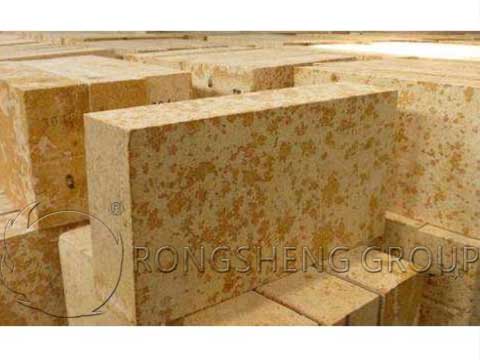
Composition of Silica Refractory Bricks
Currently, substances containing CaO, FeO, and MnO are used as mineralizing agents. The most common mineralizing agent is lime. When 2%–4% CaO is introduced into the silica brick mix, the phase composition (volume fraction) of silica refractory bricks made from calcined silica is as follows: tridymite 65%–85%; quartz 10%–20%; cristobalite 20%–30%; glass and other minerals 8%–15%. The mineralizing agent CaO and SiO2 begin solid-phase interaction, forming calcium silicate at 650℃.
Silica brick mixes can utilize the CaO-Al2O3-SiO2 system. The low-temperature eutectic mixture CaO•Al2O3•2SiO2+CaO•SiO2+SiO2 (CaO 23.3%, Al2O3 14.7%, and SiO2 62.0%) melts at 1170℃. If the original silica refractory brick batch contained 1.5% Al₂O₃, and all the alumina became a eutectic mixture, then the eutectic mixture contained CaO% = 23.3 x 1.5 : 14.7 = 2.37% and SiO₂% = 62.0 x 1.5 : 14.7 = 6.32%. Under these conditions, the amount of liquid phase formed in the silica brick was 1.5% (Al₂O₃) + 2.37% (CaO) + 6.3% (SiO₂) = 10.19%. This amount of liquid phase is close to that of glass, which is also a siliceous product made from crystalline silica and lime mineralizing agent, and is a glassy phase measured under a microscope.
To enhance the mineralization, iron oxide was added to the lime. The CaO-FeO-SiO₂ system has the most fusible melt with a melting point of 1105℃, containing 11.5% CaO, 45.5% FeO, and 43.0% SiO₂, consistent with the CaO:FeO ratio of 1:3.965. The mineralizer and liquid phase composition can also be calculated using the conditions for producing a lattice-like structure of quartz crystals. By using σ11~0.4σ1, and employing Young’s equation, we can write 0.4σ1<2(σ1-σ2cosθ), or σ1 less than 1.25σ2cosθ, thus σ2>σ1/1.25cosθ. For SiO2, σ1=300MJ/m2, using θ~60°, we obtain σ2≥480MJ/m2. The subsequent liquid phase composition, using its σ2≥480MJ/m2, is selected using the additive rule based on the known surface tension partial pressure values of the components. Since this calculation yields a small proportion of oxide content, further calculations are needed for larger proportions. The basic principles of production for many types of silica-based crystalline refractories are being theoretically studied.
Another type of non-crystalline material, whose refractory base is silicon dioxide, is a refractory material made from quartz glass. Products made from quartz glass possess unparalleled thermal shock resistance; they do not crack when heated to high temperatures and rapidly immersed in cold water. Such products represent the future direction of development. The primary challenge is to produce pure glass with a SiO2 content greater than 99%. Quartz glass products are typically manufactured using a slurry casting method, followed by firing or not firing. Quartz glass can also be used to produce fibers and products, as well as directly formed melt products, and similar items. Quartz glass ingots themselves are refractory materials and have been successfully used as the working layer in glass melting furnaces. Quartz products (ceramics) can be used relatively long-term at temperatures below 1200–1300°C and can be kept at temperatures within the range of 1600–1700°C for short periods. The main limitation to the use of quartz ceramics is the crystallization of cristobalite that occurs at approximately 1200°C. Critobalite significantly reduces the thermal shock resistance of products; the crystallization process is chemically inherent. Sufficient oxygen is required during glass production to form pure cristobalite crystals, thus crystallization occurs. Crystallization does not occur when the stoichiometric formula for SiO2 is not met. According to this concept, molten silicon dioxide is a chemical compound of the SiO2-x formula, and if there is no tendency for crystallization under certain conditions, this non-stoichiometric composition is maintained. The oxygen supplier is the impurity.