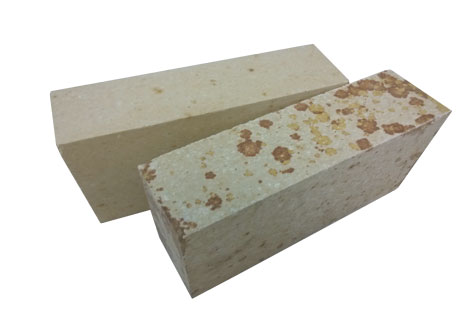
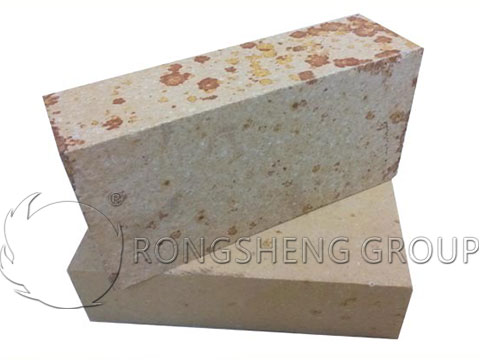
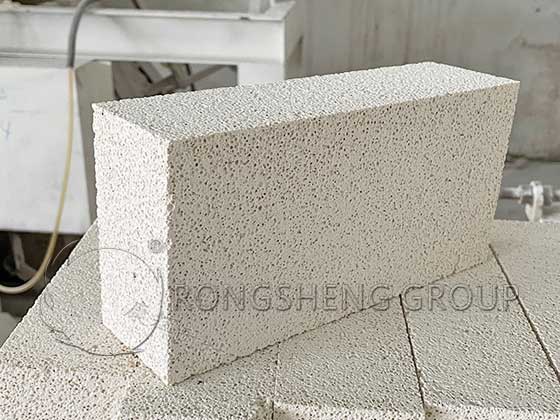
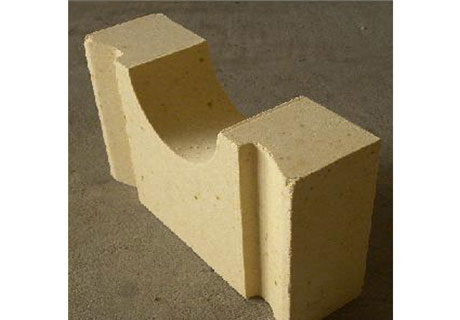
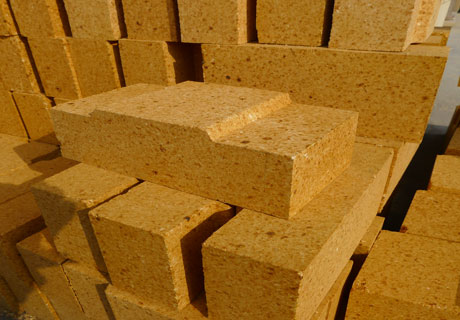
Tabular corundum mullite bricks are made primarily of tabular corundum with mullite as an auxiliary material. They are formed by adding appropriate amounts of high-purity alumina, ultrafine silica powder, and additives, and then subjected to high-pressure pressing using a 300t friction press. The bricks are then fired at high temperatures in an oxidizing atmosphere. Tabular corundum mullite bricks can be used long-term in high-temperature environments up to 1700 degrees Celsius.
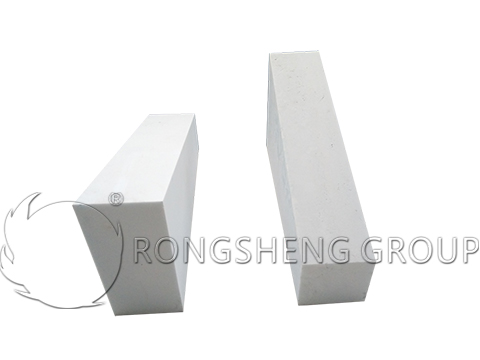
Characteristics of Tabular Alumina Mullite Bricks
- (1) Tabular alumina mullite bricks contain ≥82% Al2O3, exhibiting excellent high-temperature resistance, high refractory temperature, and a softening temperature under load up to 1700°C.
- (2) Resistant to chemical corrosion, with strong resistance to acidic solutions or slag.
- (3) Tabular alumina mullite bricks contain ≤0.5% Fe2O3, exhibiting oxidation resistance. They are not easily chemically reacted with gases such as O2, H2, and CO.
- (4) Good thermal stability, with stable volume at high temperatures, and not easily expanding or shrinking.
- (5) Good thermal shock resistance, with ≥30 water cooling cycles at 1100°C, and resistant to rapid heating and cooling without peeling.
- (6) High compressive strength at room temperature, ≥85 MPa, and not easily worn during handling or unloading.
Physicochemical Properties of Tabular Corundum Mullite Bricks
| Items | Indicators |
| Al2O3 ,% | ≥82 |
| Fe2O3, % | ≤0.5 |
| Load softening temperature, ℃ | 1700(0 deformation) |
| Thermal shock stability, secondary, 1100℃ water cooling | ≥30 |
| room temperature compressive strength, Mpa | ≥85 |
| Creep rate, %,1450℃×50h | -0.05 |
| High-temperature flexural strength, MPa, 1450℃×0.5h | ≥10 |
Applications of Tabular Corundum Mullite Bricks
Tabular corundum mullite bricks are suitable for direct flame contact, resistant to spalling, and resistant to high temperatures. They can be used as insulation linings for high-temperature industrial furnaces and as working layers in other high-temperature industrial kilns. They are mainly used in the petrochemical industry, as materials for large and medium-sized synthetic ammonia gasification furnaces and magnetic material gas furnaces, and as supporting materials for high-temperature industrial kilns. Rongsheng Refractory Materials Factory can customize refractory bricks and products of various materials and shapes according to customers’ requirements for high-temperature equipment.
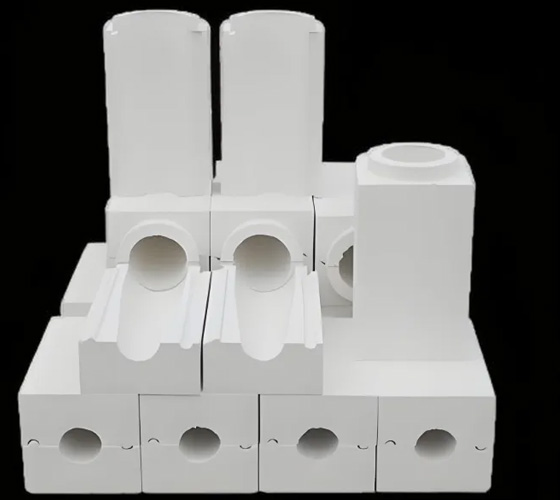
Analysis of the Causes of Edge and Corner Chipping in Corundum Mullite Bricks During Grinding and Laying
Corundum mullite bricks are one of the main products of blast furnace ceramic cups. Corundum mullite bricks still have some quality defects in terms of performance, mainly manifested in the serious edge and corner chipping phenomenon during the grinding and laying process, affecting the laying quality. By improving this phenomenon, the product’s quality pass rate can be increased by 2%, meeting the production requirements of industrial furnaces.
Analysis of the Causes of Edge and Corner Chipping in Corundum Mullite Bricks
Edge and corner chipping is a serious problem in corundum mullite bricks during the grinding and laying process. The reasons are analyzed as follows:
- Hardness. Hardness is generally considered an important indicator of a material’s wear resistance. The harder the material, the better its wear resistance. However, under conditions of significant impact and wear, hardness does not necessarily have a significant impact. Refractory bricks are heterogeneous, and the hardness of different parts may vary. For refractory bricks containing corundum and silicon carbide, if the bonding strength is sufficient, these high-hardness materials can still resist wear after the less hard and easily worn materials have worn away.
- Crystal Structure and Mutual Solubility. Materials with specific crystal structures have better wear resistance. For example, cobalt with a close-packed hexagonal structure has a low coefficient of friction and is wear-resistant. Metals with poor mutual solubility in metallurgy also have good wear resistance.
- Strength. Refractory bricks encounter a large amount of impact and wear during use. Therefore, high-strength refractory bricks have strong wear resistance.
- Bulk Density. Refractory bricks with high bulk density and low apparent porosity exhibit high wear resistance.
- Temperature. Temperature affects the hardness, miscibility, and reactivity of materials, thus indirectly influencing the wear resistance of refractory bricks. Generally, miscibility and reactivity increase with increasing temperature. Refractory bricks are used at high temperatures, making wear resistance at high temperatures crucial.
- Atmosphere. Similar to the effect of temperature, the atmosphere affects the miscibility and reactivity between materials, thereby affecting their wear resistance.
Key Technologies for Corundum Mullite Bricks
To address the above factors, the product formulation system was modified in a targeted manner: During the production process, reasonable particle size distribution and the selection and use of high-quality aggregates were employed. This increased the density of the brick blank, optimized the firing temperature, and improved the physical and chemical properties and wear resistance of the product. This ensured the quality of the subsequent grinding and laying process, thereby guaranteeing the improved quality of the precast masonry.
- 1) Using high-quality raw materials: High-quality bauxite and brown corundum raw materials were used as aggregates to ensure high hardness and increase the toughness of the refractory material without significantly increasing costs.
- 2) Increasing the proportion of brown corundum fine powder in the matrix powder, while also adding alumina micro powder, reduced the porosity of the product after firing and increased its density.
- 3) Changing the traditional product stacking method by increasing the air inlets in the kiln car stacking, resulting in a more uniform firing temperature.
- 4) Increasing the product firing temperature ensured complete sintering and sufficient bonding and dissolution of the internal materials.
Project Implementation Plan
- (1) Based on the product’s performance requirements, raw materials with high density and hardness were selected. Ultimately, a combination of brown fused alumina and bauxite was chosen. Brown fused alumina acts as a framework in terms of hardness, providing high strength to the product. Bauxite, while slightly less hard than brown fused alumina, possesses toughness and can encapsulate the brown fused alumina at a slightly lower firing temperature. This combination satisfies both product performance and economic indicators.
- (2) Building upon the existing formula, a small amount of bauxite is combined with brown fused alumina, supplemented with mullite and alumina micro-powder. High pressure is used to form the brick blank (increasing the brick’s density), resulting in a highly polymerized body. The traditional kiln stacking method is changed, increasing the width of the hand seams and improving the kiln car temperature homogenization performance. A suitable firing temperature is determined to achieve the desired effect of mutual solubility of raw materials, tight bonding, and minimal pores within the product.
Technical Summary
- Phase 1: Optimization of incoming raw materials. After investigating multiple suppliers of brown fused alumina and bauxite raw materials, and through research and discussion by the project team’s technical personnel, the brown fused alumina and bauxite were ultimately selected.
- Phase 2: Further optimization of the fused alumina-mullite product formula ratio. Multiple experiments were conducted to determine the stacking method and firing temperature. Utilizing the principle of close particle packing, the ratio of aggregate to powder was adjusted. Simultaneously, the ratio of brown fused alumina particles to bauxite particles was adjusted in various proportions, ultimately determining a 2:1 ratio to achieve a close packing effect while also providing mutual coating and solubility. 2a% alumina micro-powder was added to the matrix fine powder to increase the aluminum content and reduce porosity. A 630-ton press was used for heavy pressing to increase the bulk density of the brick blanks (from 3.1 to 3.15), widening the hand seams of the brick blanks in the kiln (increasing the width by 5mm) and increasing the kiln car fire channel, thereby increasing the firing temperature (by 40℃) to ensure sufficient melting and a dense internal structure.
- Phase 3: Trial production with multiple batches of adjusted formulations to ultimately achieve a stable production plan.
Rongsheng Corundum Mullite Bricks
Rongsheng Corundum Mullite Bricks utilize brown corundum combined with bauxite, which enhances the product’s wear resistance. However, this has a certain impact on the product’s high-temperature load softening temperature, so the bauxite proportion should not be increased. The addition of alumina micro-powder should be controlled at 2a%, which is sufficient. Excessive alumina powder affects the firing temperature and reduces the density of the brick body. In the matrix fine powder, the addition of bauxite raw materials should be reduced, and the addition ratio can be lowered to 1a% to enhance the matrix hardness. Contact Rongsheng Refractory Brick Manufacturer to obtain free samples and quotations for corundum mullite bricks.