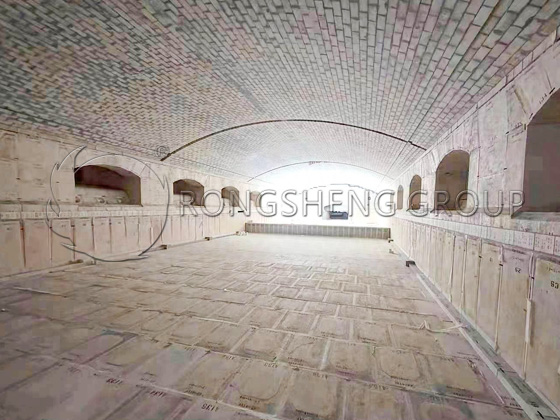
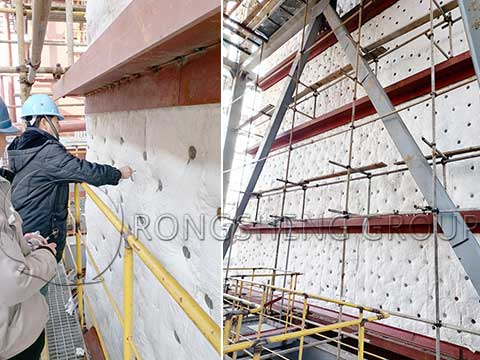
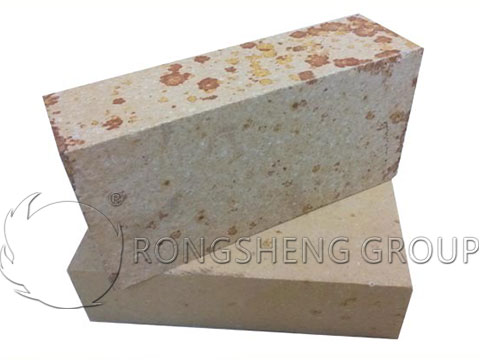
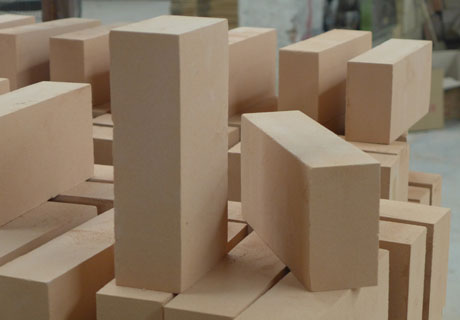
In the energy-saving and consumption-reducing design of industrial kilns, lightweight insulating bricks are a key insulation material. Their material selection and volumetric density configuration directly affect the kiln’s thermal efficiency, structural stability, and operational economy. Rongsheng Refractory Materials Manufacturer recommends the most suitable Lightweight Thermal Insulation Bricks products for the production needs of high-temperature industrial furnaces, based on factors such as the classification characteristics, selection logic, and engineering application environment of lightweight insulation bricks.
Material Classification and Applicable Temperature Range
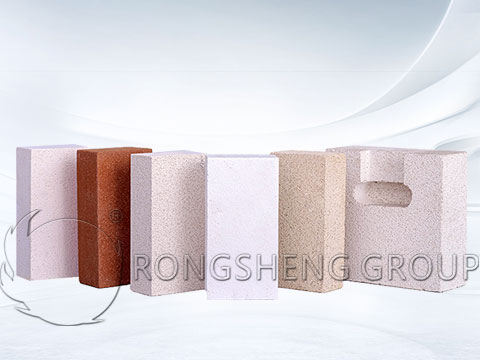
Lightweight insulating bricks can be divided into several series based on their material composition, each corresponding to a different applicable temperature range. Clay-based lightweight insulation bricks are suitable for medium- and low-temperature insulation layers below 1000℃. Due to their wide availability of raw materials and moderate cost, they currently account for a large proportion of industrial applications.
When the operating temperature increases to 1300℃, high-alumina lightweight insulating bricks should be selected. Their higher alumina content results in significantly better high-temperature resistance than clay-based products. For high-temperature conditions above 1350℃, mullite lightweight insulation bricks are required. This material exhibits good phase stability and creep resistance at high temperatures.
Furthermore, in lightweight kilns or special applications with strict limitations on the kiln’s weight, alumina bubble bricks are an ideal choice. These products combine thermal insulation with structural load-bearing capabilities.
Relationship between Bulk Density and Thermal Insulation Performance
Bulk density is a core indicator for measuring the thermal insulation performance of lightweight insulating bricks. The standard product series covers various specifications such as 1.0, 1.2, 0.8, and 0.6 g/cm³, while alumina bubble bricks mainly offer two bulk density options: 1.2 and 1.0 g/cm³.
Thermal principles show a positive correlation between bulk density and thermal conductivity: the lower the bulk density, the higher the porosity of the material, the stronger the contribution of gas-phase insulation, and the lower the thermal conductivity, resulting in superior thermal insulation performance. This characteristic not only helps reduce heat loss from the kiln and save fuel consumption but also effectively reduces the overall weight of the kiln and optimizes the foundation load-bearing design.
The Comprehensive Balance Principle of Bulk Density Selection
However, a decrease in bulk density is accompanied by a decline in mechanical properties. Insulating bricks with lower bulk density generally have lower strength at both room temperature and high temperature.
In engineering selection, it is crucial to assess the compatibility between the insulation layer and the heavy bricks in the working layer. If high-bulk-density heavy bricks are used in the working layer, and mechanical vibration or material erosion occurs during kiln operation, excessively reducing the bulk density of the insulating bricks may lead to brick crushing or abrasion, resulting in a chain reaction of problems such as insulation layer failure and heavy brick displacement, ultimately forcing a kiln shutdown for major repairs.
Therefore, when low-bulk-density insulation bricks cannot meet strength requirements, the material grade should be appropriately increased (e.g., upgrading from clay-based to high-alumina or mullite-based). The goal is to maintain reasonable bulk density while ensuring structural integrity, rather than simply pursuing ultra-low bulk density.
The Unique Application Value of Alumina Bubble Bricks
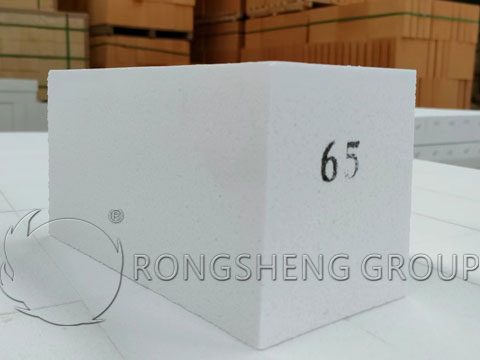
As a high-end lightweight refractory material, alumina bubble bricks break through the functional boundaries of traditional insulating bricks. These products use alumina hollow spheres as aggregate and possess a unique closed-cell structure with a bulk density controlled within the range of 1.0-1.2 g/cm³. They can meet high-temperature insulation requirements while also being used as a working layer in direct contact with the flame.
This integrated “insulation-working” design simplifies the kiln lining structure and eliminates the risks of interfacial thermal resistance and structural mismatch between the insulation layer and the heavy working layer in traditional double-layer linings. It is particularly suitable for advanced kiln systems with comprehensive requirements for lightweight lining, structural simplification, and optimized thermal efficiency.
A Balance Between Economic and Technical Aspects
Bulk density configuration directly impacts material costs. Insulation bricks with lower bulk density require higher-grade raw materials and more refined processing control, resulting in higher market prices. However, from a life-cycle cost analysis perspective, the fuel savings from high-quality insulating bricks typically far outweigh the initial investment increase.
Selection decisions should be based on a systematic evaluation of the kiln’s operating temperature, thermal regime, mechanical load, and service life, achieving an optimal balance between technical performance and economic investment.
In conclusion, the rational selection of lightweight insulating bricks is a systematic project involving material matching, bulk density optimization, and strength verification. Only by accurately grasping the dialectical relationship between temperature adaptability, insulation efficiency, and structural reliability can the kiln lining maintain a highly efficient, stable, and safe working state during long-term operation.
High-purity Alumina Bubble Bricks
Alumina bubble bricks are heat-insulating refractory products made primarily from alumina hollow spheres. They are mainly used as linings for high-temperature industrial kilns below 1800°C and as insulation layers for high-temperature thermal equipment. The manufacturing method involves melting alumina raw materials into a liquid in a tilting electric furnace. The furnace is then tilted at a certain angle, causing the solution to flow out of a pouring trough at a corresponding speed. The liquid flows through a flat nozzle at a 60°-90° angle to the flow stream, where it is dispersed by a high-speed airflow of 0.6-0.8 MPa to form alumina hollow spheres. The alumina hollow spheres, sintered alumina fine powder, and binder are then mixed in a specific ratio, molded, dried, and fired to obtain the alumina bubble bricks.
Alumina bubble bricks are a new type of high-temperature insulation material with the following advantages:
- High operating temperature: Up to 1700 degrees Celsius or higher, good thermal stability, low reheat linear shrinkage, and longer service life.
- Optimized structure and reduced furnace weight: Currently used high-temperature resistant materials are heavy bricks with a bulk density of 2.6-3.0 g/cm³, while alumina hollow sphere bricks have a density of only 1.4-1.7 g/cm³. For the same cubic meter volume, using alumina bubble bricks can reduce weight by 1.1-1.9 tons.
- Material savings: To achieve the same operating temperature, the price of heavy bricks is comparable to that of alumina bubble bricks, and a considerable amount of refractory insulation material is required. Using alumina bubble bricks can save 1.1-1.9 tons of heavy bricks per cubic meter, and also saves 80% of refractory insulation material.
- Energy saving: Hollow alumina spheres have significant heat insulation properties and a low thermal conductivity, which can effectively retain heat, reduce heat loss, and improve thermal efficiency, thereby saving energy. Energy saving can reach over 30%.
The physical properties of alumina bubble bricks are as follows:
- α-Al₂O₃ content: The α-Al₂O₃ content in alumina reflects the degree of calcination; the higher the degree of calcination, the higher the α-Al₂O₃ content. The hygroscopicity of alumina decreases with increasing α-Al₂O₃ content. Therefore, alumina used for electrolysis requires a certain amount of α-Al₂O₃. However, α-Al₂O₃ has poorer solubility in electrolytes than γ-Al₂O₃.
- Bulk density: The bulk density of alumina refers to the weight of a unit volume of material under natural conditions. Generally, alumina with a lower bulk density is more soluble in electrolytes.
- Particle size: The particle size of alumina refers to its fineness. The particle size of alumina must be appropriate; if it is too coarse, the dissolution rate in electrolytes is slow, and it may even precipitate. If it is too fine, it is easily lost through scattering.
- Specific surface area: The specific surface area of alumina refers to the total surface area of a unit weight of material, including the outer surface area and the inner pore surface area. It is an important indicator of the activity level of a substance. Alumina with a large specific surface area has good solubility in electrolytes and high activity, but it is hygroscopic.
- Abrasion coefficient: The abrasion coefficient is the percentage change in particle size distribution in an alumina sample after abrasion on a fluidized bed under controlled conditions. The abrasion coefficient is a physical indicator characterizing the strength of alumina.